


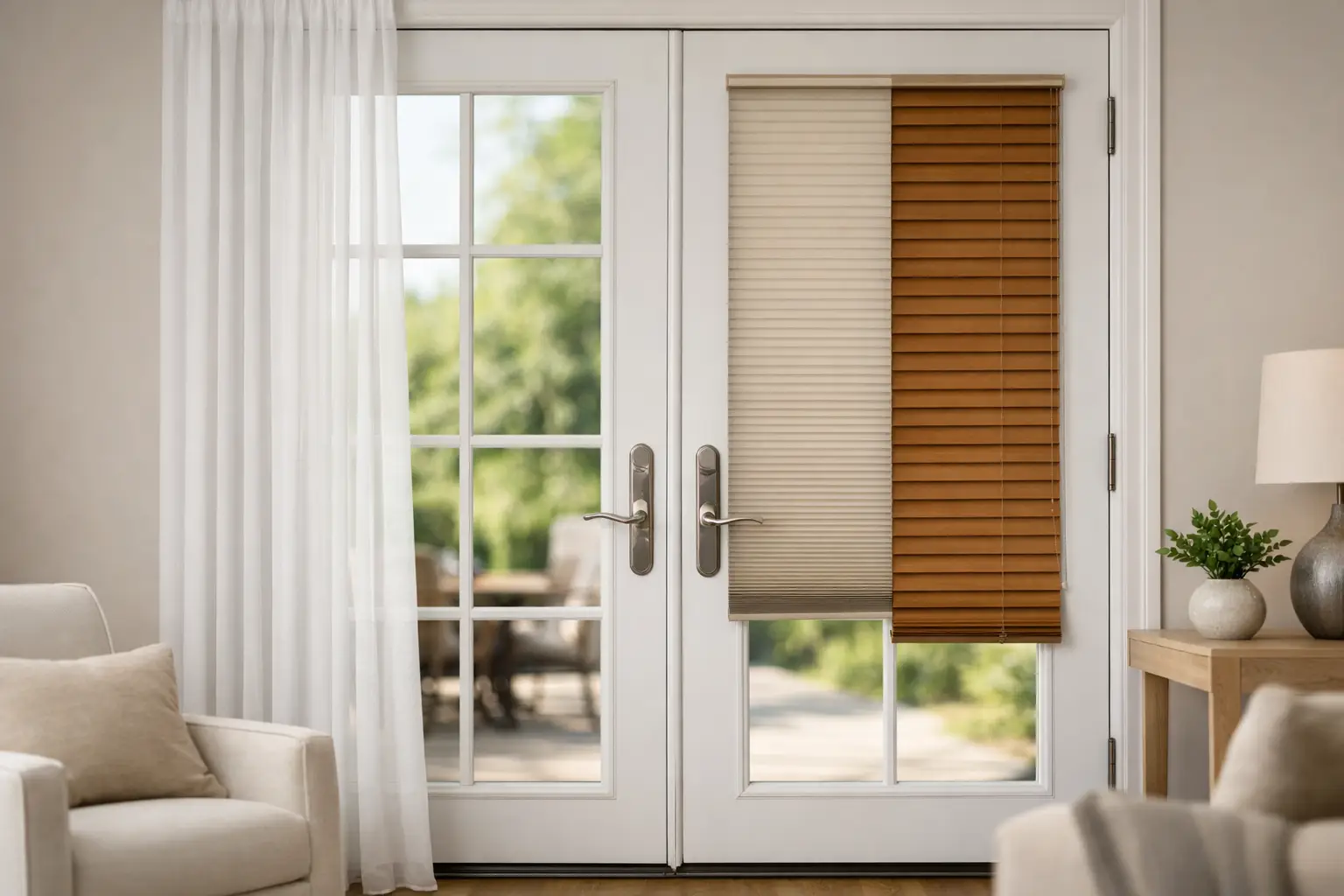
French doors earn their place in a home by bringing in generous daylight and opening a room towards the garden, patio or balcony. They can also leave you feeling exposed once dusk arrives. The top French door blinds solve both problems without stopping the doors from opening properly, catching on handles or making the room feel cluttered.
The right choice is rarely just about colour. French doors have narrow glazed panels, moving handles and opening mechanisms that need proper consideration. A made-to-measure blind that sits neatly against each door panel will usually give a smarter finish and a far more practical result than a standard off-the-shelf option.
What makes the top French door blinds different?
French door blinds need to move with the door or be positioned carefully around it. A blind fitted directly to each glazed panel stays in place when the door is opened, which means it will not swing, flap or obstruct the route outside. This is particularly useful for busy family kitchens, conservatories and living rooms where the doors are used throughout the day.
Privacy, glare control and heat management also matter. South-facing doors may need a fabric that softens harsh sun, while bedroom French doors often call for blackout material. For a room overlooking neighbouring properties, adjustable slats can offer daytime privacy without sacrificing all natural light.
There is no single best blind for every French door. The best option depends on the door design, the available fitting space, the position of the handles and how you use the room.
The best blind styles for French doors
Perfect fit and no-drill blinds
Perfect fit blinds are among the most practical choices for uPVC French doors. They are fitted within a frame around the glass rather than being drilled into the door itself. The blind becomes part of the individual door panel, allowing the door to open and close freely.
This style is especially popular where a clean, built-in look is wanted. It also avoids dangling cords, which is useful in homes with young children or pets. Available in Venetian, pleated and cellular styles, perfect fit blinds can provide anything from gentle light filtering to near-blackout coverage, depending on the fabric or slat chosen.
They are not suitable for every door, however. The glazing bead and frame design need to be checked first. A professional survey confirms whether this fitting method will work and prevents the disappointment of ordering a blind that cannot be installed correctly.
Venetian blinds
Venetian blinds offer excellent control over privacy and light. Tilt the slats upwards to reduce glare while still allowing daylight into the room, or close them fully when you want more privacy. Aluminium Venetians are slim, moisture-resistant and easy to wipe down, making them a sound choice for kitchen doors and conservatories.
Wooden-look composite slats offer a warmer appearance and can suit more traditional interiors. They are often more practical than real wood near areas with changing temperature or moisture, but their deeper slats need enough clearance around handles and door frames.
For French doors, a neatly fitted Venetian blind on each panel is usually more effective than one wide blind across the whole opening. It keeps the controls accessible and lets each door operate independently.
Roller blinds
Roller blinds suit homeowners who prefer a simple, contemporary finish. With the right fabric, they can diffuse daylight, cut glare on screens and add a strong block of colour or texture to the room. Blackout roller blinds are a popular choice for bedroom doors, media rooms and spaces where early-morning light is unwelcome.
A roller blind can be fitted above the door recess or directly to individual door panels, depending on the system and available space. Recess fitting may look tidy when the doors are closed, but it can interfere with the opening doors if the blind is left down. For frequently used doors, a panel-mounted or perfect fit roller option is usually the more convenient route.
Consider the fabric carefully. A blackout fabric helps with darkness and privacy, but light can still show around the edges of the blind. If complete room darkening is the priority, the wider window arrangement and any gaps around the doors should be assessed as part of the design.
Pleated and cellular blinds
Pleated blinds have a light, discreet appearance that works well on narrow door panels. Cellular blinds, sometimes called honeycomb blinds, have pockets that trap air and can help improve insulation at the glass. This can be valuable in a conservatory or a room that feels too warm in summer and chilly in winter.
Both options sit close to the glass and are available in a wide range of fabrics, including dim-out and blackout finishes. Their slim profile makes them a good answer where door handles leave little room for deeper slats. The trade-off is that they do not offer the same precise slat adjustment as Venetian blinds. You choose how far to raise or lower the fabric rather than tilting it to direct the light.
Vertical blinds
Vertical blinds are often better suited to wide patio doors and large glazed openings than to individual French door panels. They can cover a broad area efficiently and allow the louvres to be drawn aside when access is needed. For commercial premises, offices or garden-room openings, they remain a practical and cost-effective option.
On a pair of inward-opening French doors, though, the headrail position must be planned with care. The louvres need to clear the doors when they open. If ease of access is the main concern, panel-mounted blinds or a separate blind on each door tend to be the better choice.
Choosing fabric, colour and finish
The blind should support the way the room feels at different times of day. Pale neutral fabrics can soften bright light while keeping a kitchen or living space open and airy. Richer colours or textured weaves bring definition to a plain room and can tie in with upholstery, cabinetry or feature walls.
For privacy, do not assume a light-filtering fabric will be private after dark. When the lights are on inside, silhouettes may still be visible from outdoors. A dim-out or blackout fabric gives greater reassurance, particularly for ground-floor bedrooms and doors facing a road or neighbouring garden.
If your French doors receive strong afternoon sun, solar-reflective or UV-protective fabrics can help reduce glare and protect furnishings from fading. Insulating cellular fabrics are worth considering when comfort and energy efficiency are higher priorities than a slatted look.
Fitting details that should not be overlooked
The smallest measurements make the biggest difference on French doors. Handle depth, hinge position, glazing bead shape and the direction the doors open can all affect which blind will fit. A blind that looks ideal in a showroom may not work on a particular frame without the right system or bracket.
Child safety should also be part of the decision. Where cords or chains are used, they need to be secured correctly with suitable safety devices. Cordless, tensioned and motorised options can reduce loose-control concerns and create a cleaner finish.
Motorised blinds can be particularly useful for tall or hard-to-reach glazed doors, although they are not essential for every installation. They are a worthwhile consideration where several blinds need operating together, where accessibility is important or where you would like regular light control without adjusting each blind manually.
Why made-to-measure is worthwhile
French doors are not forgiving of approximate sizing. A blind that is even slightly too wide may rub against handles or frames. One that is too narrow can leave awkward gaps and reduce privacy. Made-to-measure blinds are tailored to the actual glass, frame and fitting method, rather than relying on a standard size to do a specialist job.
At Queen Blinds, a free home appointment allows the doors to be assessed in person, fabrics to be viewed in the room’s natural light and practical details to be resolved before fitting. This is often the easiest way to compare options honestly, especially when deciding between a blackout roller, adjustable Venetian or close-fitting cellular blind.
A well-chosen blind should make French doors easier to live with, not give you another thing to move before stepping outside. Start with how the doors are used, then choose the style that gives you the privacy, light control and finish your room needs.