


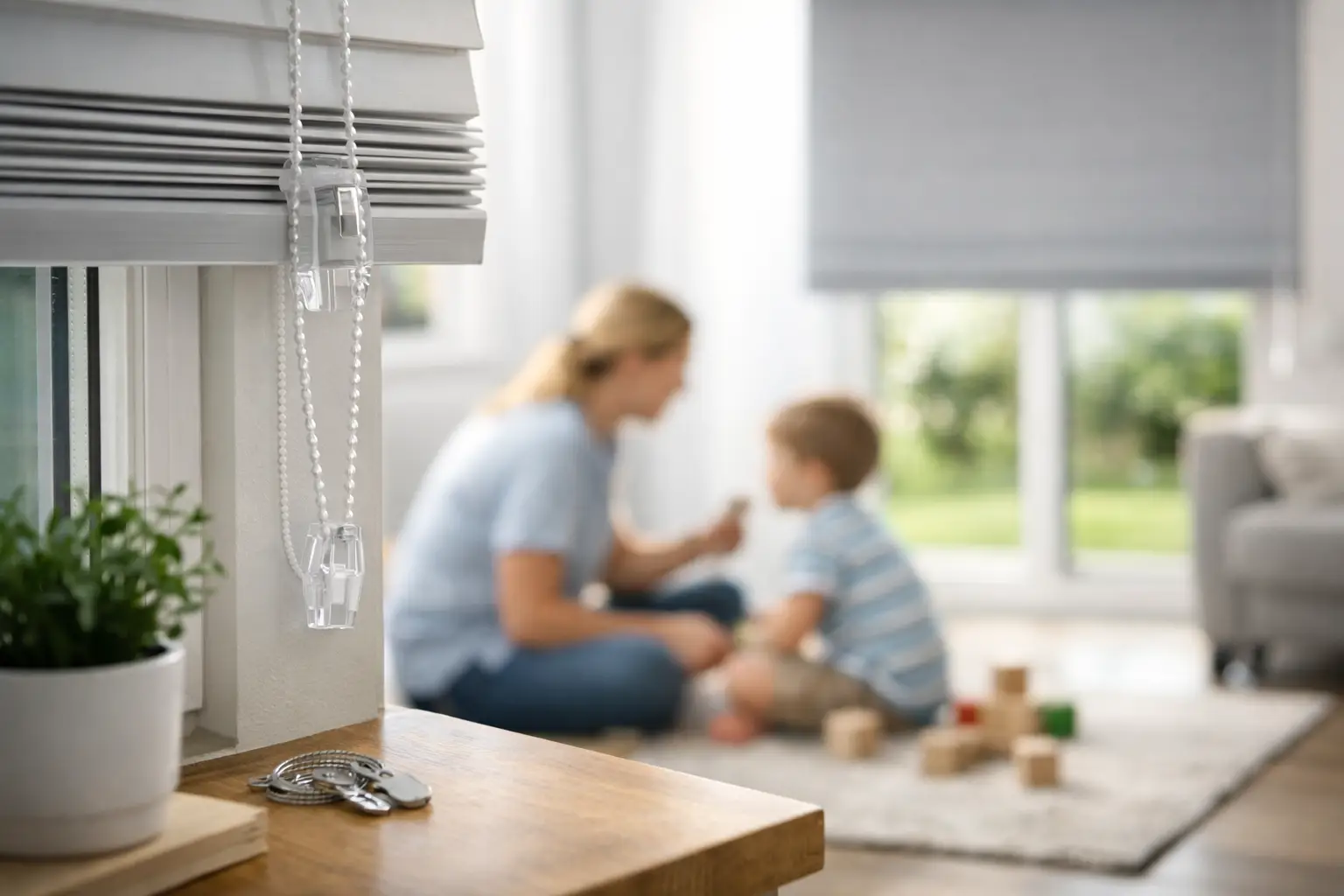
A blind that looks excellent at the window can still create a risk if its controls are not selected and fitted properly. This guide to blind safety standards explains what homeowners, landlords and commercial property managers need to know when choosing made-to-measure blinds, particularly where babies and young children may be present.
Blind safety is not simply about adding a small device after fitting. It starts with choosing an appropriate control system for the room, measuring accurately and ensuring every safety component is secured to the wall, frame or recess as intended. Done well, it gives you privacy, light control and a polished finish without creating unnecessary hazards.
A guide to blind safety standards: what they cover
In the UK, internal blinds with cords and chains are subject to child safety requirements. The key standard is BS EN 13120, which covers performance and safety requirements for internal blinds. The UK Blind Cord Safety Regulations 2014 made important child safety provisions mandatory for new internal blinds and curtains supplied for domestic use.
The purpose is straightforward: to reduce the risk of a child becoming entangled in a looped cord, chain or operating cord. Young children can get into difficulty very quickly, often when climbing near a window or playing around furniture. A cord that appears well out of reach from the floor may not remain so once a cot, chair, toy box or sofa is nearby.
Compliant blinds are designed to address this risk in different ways. Depending on the product, this may mean a chain tension device fixed to a suitable surface, a cord cleat to hold operating cords securely out of reach, a breakaway device, or a control system that removes accessible loops altogether. The right solution depends on the blind style, window position and the people using the space.
Standards and product specifications can change, so it is sensible to choose a reputable supplier who can explain the safety features supplied with your particular blind and fit them correctly.
Why the blind type makes a difference
There is no single safest blind for every room. The best choice depends on how the room is used, the size and shape of the window, your preferred look and whether children regularly have access to the area.
Cordless and wand-controlled blinds reduce reliance on loose operating cords. Roller blinds can be specified with spring-assisted or motorised operation, while Venetian blinds may use a wand for tilting. Motorised blinds offer a particularly tidy option for hard-to-reach windows, large glazing and busy family rooms, although they require consideration of power supply, controls and budget.
Corded or chain-operated blinds can still be suitable when they are supplied and installed with the correct child safety devices. Roller blinds commonly use a continuous chain that is held under tension by a properly fixed device. Vertical blinds may use chain and cord controls, which need to be kept secure and free from loops. The crucial point is that the safety device is part of the installation, not an optional extra to leave in the packet.
For bedrooms, a blackout roller blind may be the practical choice for better sleep and light control. In a kitchen or office, a moisture-resistant roller blind or easy-clean Venetian blind may suit the room better. Safety and everyday performance should be considered together rather than treated as competing priorities.
Choosing safer blinds for family homes
Begin with the room, not the catalogue. Nurseries, children’s bedrooms, playrooms and living rooms with low furniture call for the closest attention, but risks can arise anywhere a child visits. A guest room may contain a travel cot, while grandparents’ homes often need the same care as a young family household.
Look around the window before deciding on a control. If a bed, cot, chest of drawers, window seat or radiator cover could allow climbing, a blind control must remain safely out of reach. Moving furniture helps, but should not be the only measure. Children explore, furniture gets rearranged and visiting children may not be familiar with the room.
Made-to-measure blinds are helpful here because the control side, chain length and fitting position can be considered as part of the design. They also avoid the poor fit, excess material and improvised alterations that can occur with off-the-shelf products. A professional measure gives the installer a chance to assess the recess, the wall surface and the practical use of the space before the blind is ordered.
Where possible, choose a control system with fewer accessible cords. If you prefer a traditional chain-operated blind, make sure the required tensioner or retaining device can be fixed securely. A device that is not attached to a sound surface cannot perform its safety function properly.
Safe fitting is as important as compliant products
A blind may leave the factory with suitable safety components, but it only becomes safer when those components are installed correctly. This is one reason professional fitting is valuable, especially in older properties where plaster, tiled surfaces, steel lintels or awkward window recesses can make fixing more complicated.
The fitter should select a secure fixing point and use appropriate fixings for the surface. Do not attach a chain tension device with temporary adhesive pads unless the manufacturer specifically permits it. Equally, do not shorten, remove or reposition components without checking the blind instructions. Altering the control mechanism can affect both operation and safety.
After fitting, test the blind as it will be used day to day. The chain or cord should move smoothly, the safety device should remain firmly fixed, and there should be no loose loop hanging beneath it. If the blind has a breakaway component, make sure everyone responsible for the property understands what it does and how it should be refitted if it separates.
It is also worth thinking about windows that are opened regularly. A blind control should not interfere with handles, restrict escape routes or create a snagging point around opening sashes. In commercial settings, controls should be positioned sensibly for staff use while remaining secure in public-facing areas.
Landlords and commercial properties have ongoing duties
For landlords, blind safety should form part of the regular condition checks between tenancies. A previous occupant may have removed a tension device, moved furniture beneath a window or damaged a cord. Replacing only the blind fabric is not enough if the operating system has become unsafe.
In offices, schools, clinics, rental properties and hospitality spaces, the risk assessment is broader. Children may not be the main occupants, but visitors, clients and families can still use the building. High-traffic areas also place more wear on mechanisms and fixings. Durable, easy-to-clean blinds with simple controls are often the most practical long-term choice.
Keep a record of when blinds were fitted, what safety devices were installed and when they were checked. This is particularly useful for managed properties with multiple rooms or frequent turnover.
A simple blind safety check for existing window coverings
Even if your blinds were fitted some time ago, a quick inspection can identify issues before they become a problem. Check each window rather than assuming one room is the same as another.
- Make sure chains, cords and loops are held out of reach of children and are not dangling freely.
- Check that tension devices, cord cleats and brackets are firmly attached and have not worked loose.
- Move cots, beds, chairs and other climbable furniture away from windows and blind controls.
- Look for frayed cords, cracked plastic components, damaged chains or stiff mechanisms that need attention.
- Confirm that anyone cleaning, decorating or moving furniture knows not to remove safety fittings.
If a component is broken or missing, avoid treating it as a minor cosmetic issue. Stop using the blind if necessary and arrange a suitable repair or replacement. A new blind may be the better value option where the mechanism is worn, the fitting is insecure or the product no longer suits the room.
Practical advice from measuring to fitting
The most reliable route is to discuss safety requirements during a home appointment, before a blind is made. Explain who uses each room, whether children visit, what furniture sits below the window and whether you want manual or motorised operation. These details allow better recommendations than choosing by colour alone.
Queen Blinds can help homeowners and businesses across Coventry and the West Midlands select made-to-measure blinds that balance style, privacy, blackout control and safer operation. Accurate measuring and professional fitting help ensure that the finished blind looks right and that its safety features work as intended.
A well-chosen blind should make a room more comfortable to live or work in. Taking a few minutes to consider its controls and fitting gives that finishing touch the care it deserves.