


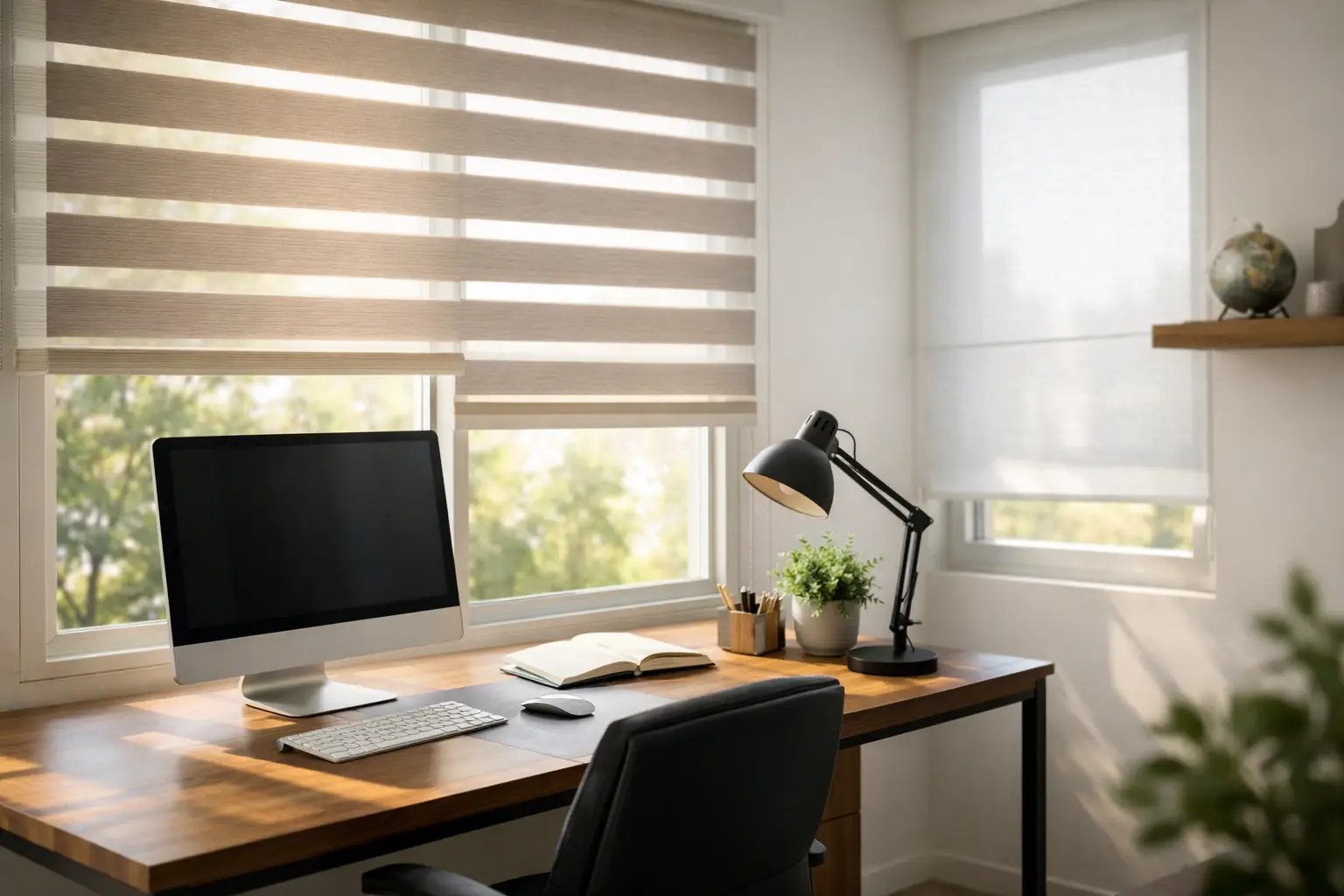
A home office can look perfectly organised and still be difficult to work in if the window is working against you. Low sun across a monitor, reflections during video calls, afternoon heat and a lack of privacy can all make a room feel less productive. The right blinds for home offices give you practical control over daylight without making the space dark, cramped or disconnected from the outdoors.
For many households, the office is no longer a spare room used occasionally. It may be where you meet clients, manage a business, study, or concentrate through a full working day. That makes a made-to-measure blind a useful part of the room’s setup, rather than simply a finishing touch.
Start with the way the room is used
The best option depends on more than the shape of the window. Consider where the desk sits, which direction the window faces and when the room receives the strongest sunlight. A south- or west-facing office often needs greater glare and heat control, while a north-facing room may benefit from a blind that preserves as much natural light as possible.
Also think about what happens on screen. Direct daylight can make it hard to read documents, while bright light behind you can leave your face in shadow on a video call. If your desk faces the window, you may need a blind that filters light evenly. If the window is behind the screen, the priority is often reducing reflections without blocking daylight altogether.
Privacy matters too, particularly in a ground-floor study, a converted front room or a home office overlooked by neighbouring properties. A good blind lets you work comfortably during the day and close the room off when the working day ends.
Roller blinds for clean, focused spaces
Roller blinds are a popular choice for home offices because they are neat, uncomplicated and available in a wide choice of fabrics and colours. They sit close to the window, making them especially useful where a desk, shelves or radiator are positioned nearby.
A sunscreen or light-filtering roller fabric can soften harsh daylight and cut screen glare while still allowing a view outside. This can be a particularly good fit for rooms used throughout the day, where total darkness would feel too enclosed. For a room that doubles as a guest bedroom or media space, blackout roller blinds offer a stronger level of light control.
The trade-off is straightforward: blackout fabric is excellent for stopping light, but it will not give you the same daytime view as a screen fabric. Some customers choose blackout for offices with intense sun, while others prefer a dim-out or solar fabric that keeps the room brighter. The right decision comes down to how often you need to see the screen clearly compared with how much daylight you want to retain.
Roller blinds can also be motorised. This is useful for large windows, hard-to-reach windows or busy working days when you want to adjust the light without leaving your desk. Motorised controls can make a home office feel more considered and convenient, but a simple chain-operated blind remains a dependable, cost-effective choice for many rooms.
Venetian blinds offer precise light control
Venetian blinds are well suited to offices where the sun changes position throughout the day. By tilting the slats, you can direct light towards the ceiling, reduce glare on a monitor and maintain a degree of visibility outside. When privacy is needed, the slats can be angled to limit views in without closing the blind completely.
Aluminium Venetian blinds have a crisp, contemporary appearance and are easy to maintain, making them a practical option for a modern study or commercial-style workspace. Wooden-look composite Venetians bring a warmer finish and can suit home offices that need to feel more connected to the rest of the house.
It is worth considering the wider room scheme. Slatted blinds create more visual detail than a roller blind, which can look attractive in a larger office but may feel busy in a compact space with lots of shelving and equipment. They are also best kept clear of clutter around the window so the slats can be tilted and raised easily.
Vertical blinds work well for wide windows
Vertical blinds are often associated with larger openings, and for good reason. They are a practical choice for wide windows, bay windows and patio doors in a home office or garden room. Each louvre can be tilted to control the direction of light, helping reduce glare while keeping the space naturally lit.
They are also useful where a workspace opens onto the garden, as the blind can be drawn to one side for access. With a choice of fabrics, colours and finishes, vertical blinds can look far more tailored than their purely functional reputation suggests.
For a narrow window, however, a roller or Venetian blind may give a cleaner result. Accurate measuring is particularly important with vertical blinds, as the track, louvre length and clearance around furniture all affect how the finished blind operates.
Choose fabrics and finishes for performance first
A home office blind should suit the décor, but performance deserves equal attention. Light-filtering fabrics are ideal for taking the edge off bright daylight. Blackout fabrics are better where glare is severe or the room has more than one use. UV-protective fabrics can help reduce fading on floors, furniture and documents near the window.
Colour has an effect on both appearance and light. Pale neutral shades can keep a smaller office feeling open and work well with changing décor. Darker colours can add definition and may be useful where you want a more enclosed, focused atmosphere. They can also show dust more readily, depending on the fabric and the amount of sunlight in the room.
For homes concerned about warmth in winter and overheating in summer, consider blinds with insulating qualities. A well-fitted blind creates an additional barrier at the window, helping the room feel more comfortable. It will not replace proper glazing or heating, but it can make a noticeable difference in an office used for long periods.
Made-to-measure fitting avoids everyday frustrations
Off-the-shelf blinds can be tempting, especially for standard-looking windows. Yet home office windows are often less straightforward than they appear. Recess depths vary, handles can obstruct the blind, and even a small gap can allow a distracting strip of sunlight onto a screen.
Made-to-measure blinds are designed around the actual window and the way you use the room. A professional consultation can identify whether a recess fit or face fit is most suitable, check for obstructions and recommend a fabric or slat type that meets your priorities. This is particularly valuable for bay windows, unusually shaped openings and large glazed areas.
Expert fitting also gives the blind its finished appearance. A blind that sits level, clears handles and operates smoothly is easier to live with every day. Where young children are at home, suitable child-safety measures should form part of the fitting plan, especially for blinds with operating chains.
Create a workspace that works beyond nine to five
Your office does not need to look like a corporate meeting room to be practical. Soft neutral roller blinds can create a calm background for video calls, while wood-effect Venetians can add warmth to a study with traditional furniture. In a multi-purpose room, blackout options can help the space switch from work to rest without compromise.
For homeowners and businesses across Coventry and the West Midlands, Queen Blinds provides free home appointments, professional measuring and fitting, making it easier to choose with confidence rather than guessing from a sample online. Seeing fabrics and finishes in the actual room can quickly show how a colour responds to daylight and whether the level of privacy feels right.
The most useful blind is one you barely have to think about once it is fitted. It should take the glare off your screen, support your privacy and make the room a more comfortable place to spend the day – leaving you free to focus on the work in front of you.