


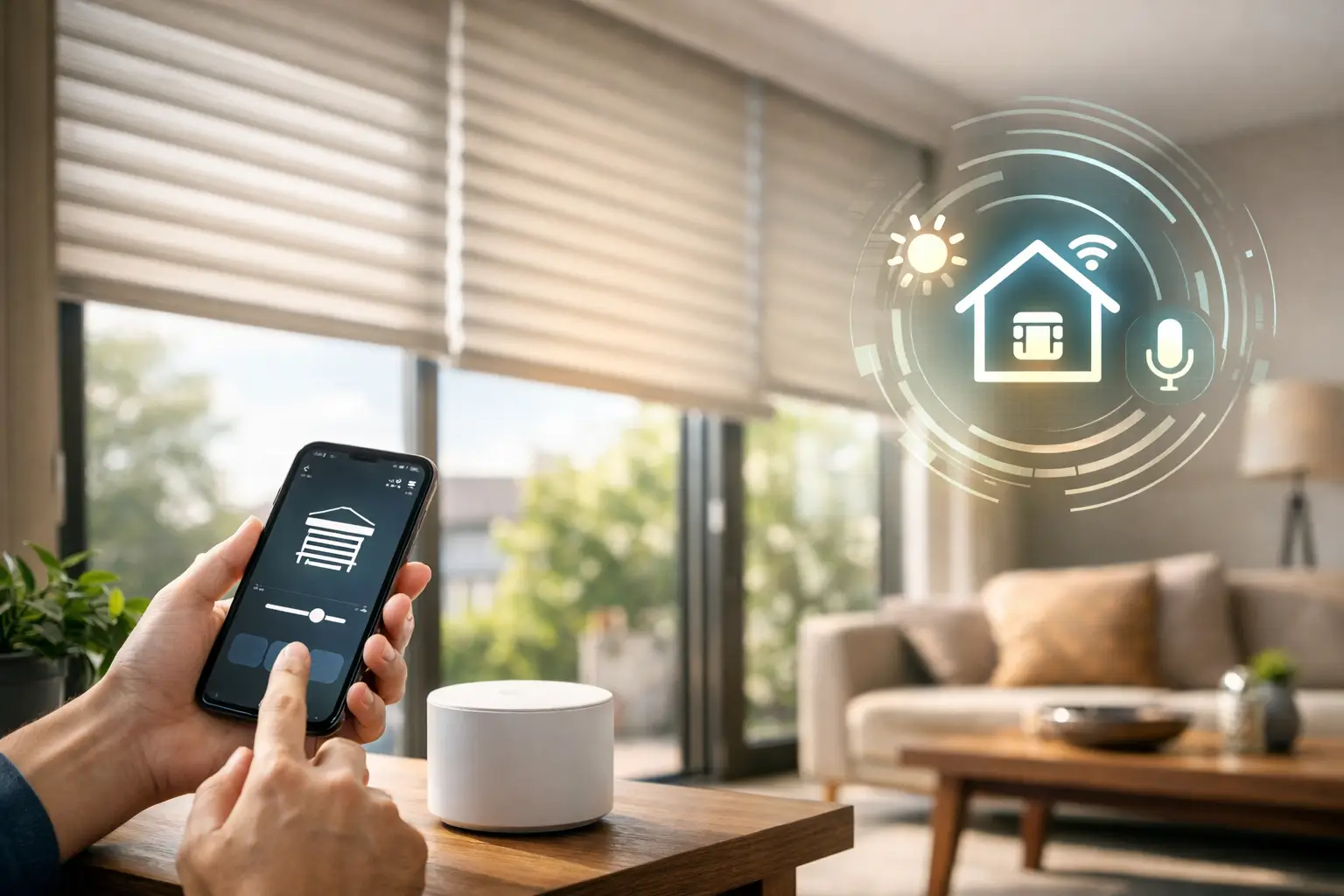
A blind that rises before sunlight hits the television screen, closes at bedtime without a walk around the house, and still looks right for the room is no longer a novelty. The most useful smart blinds trends 2026 are less about adding technology for its own sake and more about making everyday spaces calmer, more comfortable and easier to manage.
For homeowners, landlords and businesses across Coventry and the West Midlands, the real question is not whether a blind can connect to an app. It is whether the finished window covering gives the right privacy, light control and fit, while being simple enough to use every day.
Smart blinds trends 2026: useful, quieter technology
The strongest trend for 2026 is practical automation. Motorised blinds are becoming a considered part of a room scheme rather than a gadget added at the end of a renovation. Customers want controls that work reliably, look discreet and do not make the room feel overly technical.
Quieter motors are a key part of that change. A motorised roller blind in a bedroom, nursery or home office should move without becoming the centre of attention. This matters particularly in open-plan homes, where noise travels, and in offices where blinds may be adjusted during meetings.
Battery-powered options remain appealing where running a mains supply to each window would be disruptive. They can be a sensible choice for existing properties, rental homes and windows that are difficult to reach. Wired systems can suit a larger refurbishment or new build, especially where several blinds will be used frequently. Neither option is automatically better: the right answer depends on access, window layout, usage and the work planned for the property.
Control is becoming more personal
Remote controls are still useful, particularly for one-room installations or for customers who simply prefer a dedicated handset. However, app and voice controls are now expected to offer a genuine convenience rather than a complicated set-up process.
The most valuable feature is scheduling. A bedroom blackout blind can close at a chosen evening time, helping create a more consistent routine. In a south-facing living room, a roller blind can lower during the brightest part of the afternoon to reduce glare. At a commercial property, blinds can be set to manage light before staff arrive.
This does not mean every blind needs a different programme. Too much automation can become a nuisance if it works against changing routines, school holidays or the British weather. A well-planned installation usually starts with a few simple scenes: morning, evening, television time or away from home. These are easy to remember and easy to adjust.
Solar control is moving up the priority list
Rising energy costs continue to shape how people choose window coverings. Smart blinds cannot replace proper insulation, but they can support a more comfortable indoor temperature when the fabric and timing are chosen carefully.
During summer, closing blinds before direct sun pours through a large window can help limit heat build-up. In winter, insulated or blackout fabrics can add a useful layer at the window, particularly in bedrooms and rooms that feel chilly after dark. The effect will vary with glazing, room orientation, draughts and the blind style, so broad claims about energy savings are rarely helpful.
For many homes, the immediate benefit is comfort: less glare on screens, fewer overly warm afternoons and a cosier feel in the evening. For offices, managing glare can make desks near windows more usable without shutting out daylight all day.
Made-to-measure remains essential
Technology does not make inaccurate measurements more forgiving. If anything, motorisation makes a precise fit more important, because the blind needs to operate freely and sit neatly within the space.
Large glazing, bay windows, bifold doors and high-level windows are all driving demand for bespoke solutions. A made-to-measure roller blind can be specified with the fabric, finish and control method suited to the room, rather than forcing the room to work around an off-the-shelf size.
This is also where professional advice saves time. A blackout fabric may be the clear choice for a bedroom, but a kitchen might need a wipe-clean material that handles moisture and everyday splashes. A wood-look Venetian blind can bring a warmer finish to a lounge while offering flexible light control, whereas vertical blinds may be more practical for wide windows or commercial settings.
The smart feature should support the blind type, not dictate it. A beautifully controlled blind that is difficult to clean, blocks too much light or clashes with the room will not feel like a good investment for long.
Safety and accessibility are shaping specifications
Families remain rightly focused on child safety. Motorised blinds can reduce the need for loose operating cords, making them a worthwhile option in children’s bedrooms, playrooms and family living areas. The exact safety approach will depend on the product and installation, but removing unnecessary cords can make a room feel tidier as well as safer.
Accessibility is another reason smart control is becoming more popular. Windows behind furniture, over a bath, above a stairwell or in rooms used by someone with reduced mobility can be difficult to manage manually. Remote or app control makes these windows easier to use without compromising on privacy or shading.
For landlords, straightforward controls also matter. A system should be intuitive for new tenants and not require lengthy instructions. In many cases, a simple remote-controlled blind offers the best balance between convenience, maintenance and cost.
Design is becoming softer and more considered
The visual direction for 2026 is warm, quiet and adaptable. Neutral shades are still popular, but customers are moving away from plain white as the default. Soft stone, sand, warm grey, muted green and natural woven textures can give a room more depth without making a strong colour commitment.
Layered window treatments are also becoming more common. A practical blind can handle privacy and light control, while curtains add softness and insulation. In bedrooms, a blackout roller blind behind curtains is a particularly effective pairing for those who want a darker room without losing the finished look of fabric drapes.
For contemporary spaces, clean-lined roller blinds remain a natural match for motorisation because their operation is simple and the finished appearance is uncluttered. Venetian blinds continue to appeal where adjustable light is the priority. The trend is not about one style replacing another; it is about choosing the finish that matches how the room is used.
Smart features for commercial spaces
Business owners and office managers are increasingly considering motorised blinds for meeting rooms, reception areas and screen-based workspaces. A single control can adjust several blinds at once before a presentation, while scheduled settings can help reduce glare at predictable times of day.
Commercial projects need a practical specification. Fabrics may need to be hard-wearing, easy to maintain and suitable for the level of privacy required. In a customer-facing setting, the blind should also look polished when open and closed. A reliable fitting service is particularly valuable where multiple windows, access restrictions or business hours make installation more complex.
What to consider before choosing smart blinds
Start with the room rather than the technology. Think about when glare occurs, whether privacy is needed during the day or only at night, how often the blind will move, and who will use it. Then consider power options and controls alongside the fabric and style.
It is worth checking signal strength for app-controlled systems, especially in extensions, garden rooms or commercial buildings with thicker walls. Ask how the blind will be charged or powered, what happens if a remote is misplaced, and whether several blinds can be grouped together. Clear answers now prevent frustration later.
A free home appointment also gives you the chance to see fabric samples against the actual light in your room. What looks like a warm neutral in a showroom can appear cooler in a north-facing room, while a darker fabric may offer better glare control than expected. At Queen Blinds, expert measuring and fitting help ensure the technology, fabric and final finish work together properly.
Smart blinds are most successful when they quietly solve a daily problem. Choose the features you will genuinely use, match them to a made-to-measure blind that suits the space, and you will have a window covering that feels considered long after the novelty has worn off.