


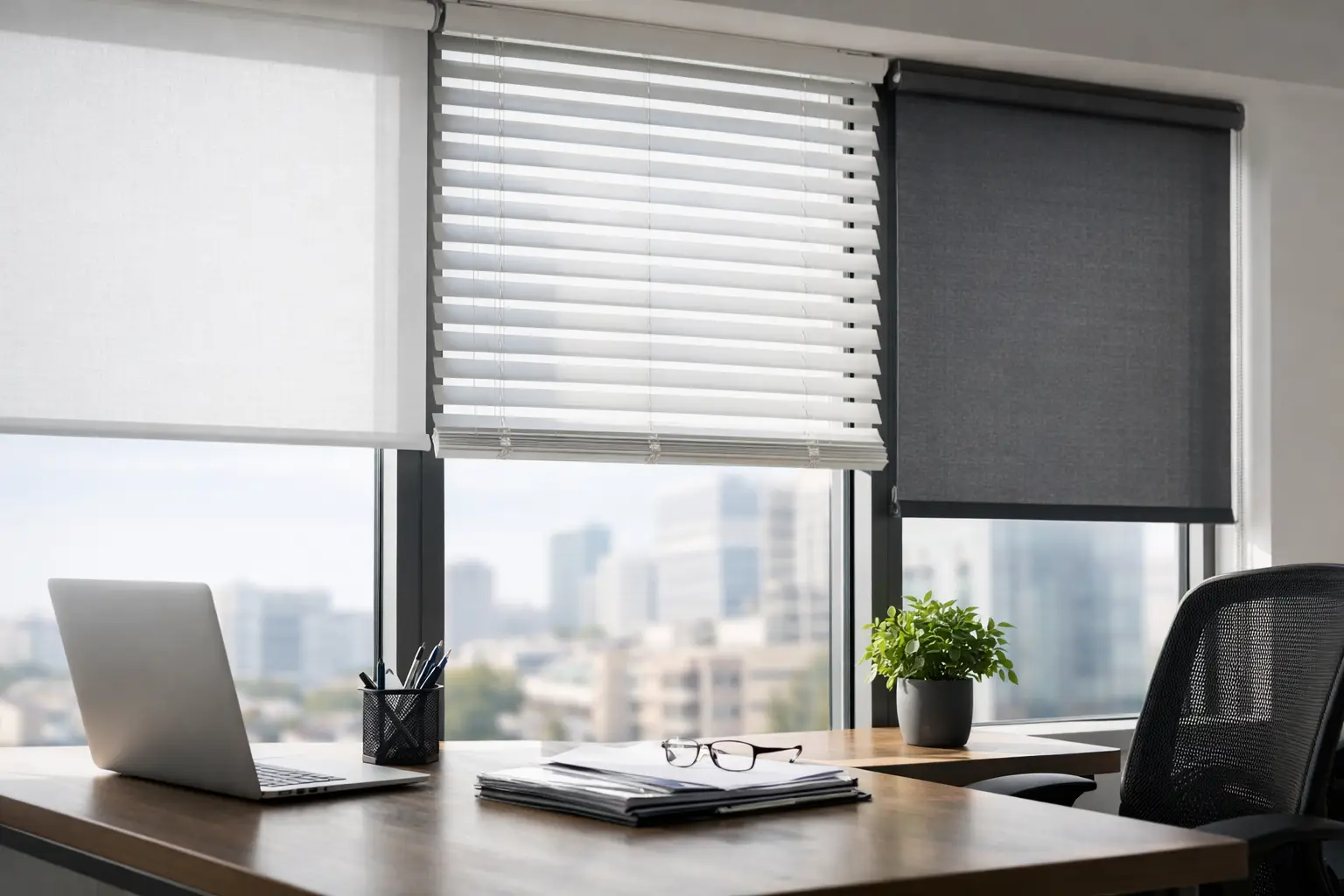
A poorly chosen office blind is noticed quickly: screens become hard to read in afternoon sun, meeting rooms feel exposed, and staff spend more time adjusting the light than getting on with their work. Knowing how to choose office blinds means balancing appearance with the everyday demands of the space, from privacy and glare control to cleaning, safety and accurate fitting.
The right choice is rarely the same for every room. A client-facing reception, a bank of desk screens and a private meeting room may all need different levels of light control. Start with how each area is used, then select a made-to-measure blind that supports it.
How to Choose Office Blinds by Room Use
Before focusing on colours or finishes, look at what happens in the room throughout the working day. Which windows receive direct morning or afternoon sunlight? Is the office overlooked by neighbouring properties or pedestrians? Are staff working on screens close to the glass?
Open-plan offices usually need controlled daylight rather than complete darkness. Too much sun creates glare and heat, while blocking every bit of natural light can make a workspace feel closed in. Meeting rooms may need a stronger solution if presentations are regularly shown on a screen. Ground-floor offices, clinics and customer service spaces often need more privacy without making the room feel unwelcoming.
It also helps to consider who will operate the blinds. In a small office, manual controls may be perfectly practical. For high windows, large glazed areas or shared rooms, motorised options can make daily adjustment far simpler and more consistent.
Start With Light Control and Screen Glare
Glare is one of the most common office complaints, particularly where desks face windows or afternoon sun falls directly across monitors. The best blind should soften bright light without forcing staff to work in a dim room.
Roller blinds are a popular choice for offices because they offer a clean, uncluttered finish and a wide choice of fabrics. A screen or dim-out fabric can reduce glare while still allowing a degree of daylight into the room. This makes it well suited to general workspaces where visibility and comfort matter more than total blackout.
For presentation rooms, training spaces or areas with projectors, blackout roller blinds provide more complete light control. They are also useful where a room doubles as a private consultation space. Keep in mind that standard blackout fabric reduces light through the fabric, but small gaps around the edges can remain. If near-total darkness is essential, the blind system and fitting details need to be planned carefully.
Venetian blinds allow you to tilt the slats and direct light upwards or away from desks. That extra control is valuable in offices with changing sunlight across the day. Vertical blinds offer a similar benefit on wide windows and patio-style doors, where their louvres can be angled to manage glare while maintaining a view outside.
Choose a Style That Suits the Window
Office blinds should look professional, but they also need to work with the size and shape of the window. A blind that suits a compact reception window may not be the most practical option for a long run of glazing.
Roller blinds for a neat, versatile finish
Roller blinds suit most commercial settings, including receptions, private offices, salons, healthcare spaces and meeting rooms. Their simple profile works with modern interiors and makes them easy to keep tidy. They are available in plain, textured and patterned fabrics, so it is possible to introduce brand colours or soften a clinical-looking room without making the window treatment distracting.
They are particularly effective when you need a consistent look across several rooms. For windows that are difficult to reach, motorisation can be a sensible upgrade rather than a luxury.
Venetian blinds for adjustable daylight
Venetian blinds are a strong option for offices where occupants want to fine-tune daylight and privacy during the day. Aluminium slats give a crisp, contemporary appearance and are straightforward to wipe clean. Wooden-look composite slats can add warmth to a boardroom or client area while offering a more practical alternative to natural wood in humid or high-use settings.
The trade-off is that slats require more individual cleaning than a roller blind. They are worth considering where flexible light direction is a priority, but may be less suitable where the office needs the lowest-maintenance option possible.
Vertical blinds for wider glazing
Vertical blinds work especially well on large windows, wide bays and doors. Their louvres can be drawn to one side for access, making them useful for rooms with external doors or wide glass panels. They offer good coverage and adaptable privacy, while fabric choices can help reduce brightness and soften the room acoustically.
For a formal executive space, some businesses prefer the more minimal line of a roller blind. For a practical workplace with broad glazing, however, vertical blinds are often a very cost-effective choice.
Consider Privacy, Heat and Energy Efficiency
Privacy means different things in different workplaces. A street-facing office may need to prevent people seeing computer screens or confidential paperwork. A meeting room may need visual separation from neighbouring buildings. In these situations, choose a fabric or slat arrangement that gives privacy during the relevant part of the day, not just when the blinds are fully closed.
If your office gets hot in summer or feels chilly near the windows in winter, blinds can support a more comfortable indoor environment. Thermal and solar-control fabrics help reduce the impact of direct sunlight and can limit heat build-up. Insulating layers can also help reduce heat loss through glass when the blinds are closed.
Blinds are not a replacement for effective glazing or heating, but they are a practical addition for businesses looking to improve day-to-day comfort and manage energy use. South- and west-facing windows often benefit most from stronger solar protection, while shaded rooms may only need light-filtering fabric.
Think About Cleaning and Long-Term Maintenance
A busy office needs blinds that will continue to look presentable without demanding excessive upkeep. Roller blinds are generally the simplest: regular gentle dusting and occasional spot cleaning will usually keep them in good order. Aluminium Venetians can be wiped down, which makes them useful in kitchens, treatment rooms and other spaces where hygiene is a priority.
Fabric vertical blinds can be practical for larger windows, but choose a durable material and allow for periodic cleaning. The ideal option depends on the environment. A quiet professional office may prioritise texture and appearance; a high-footfall premises may place more value on wipe-clean finishes and easy replacement of individual parts.
Also consider the position of desks, radiators, door handles and window openings. A blind may look right on paper but become inconvenient if it catches on furniture or prevents a window from being used properly.
Do Not Overlook Safety and Operation
Any blind with cords or chains should be specified and fitted with safety in mind, particularly in offices that welcome families, operate from shared buildings or have childcare facilities nearby. Professional fitting ensures controls are positioned correctly and safety devices are installed as required.
For large installations, motorised blinds can improve safety and reduce wear from repeated manual use. They are helpful for high-level windows, multi-window meeting rooms and spaces where blinds need to be adjusted quickly before a presentation. The key question is not whether automation sounds impressive, but whether it will make the room easier to use every day.
Measure Properly Before You Order
Made-to-measure blinds are particularly valuable in commercial spaces, where windows are often wide, recessed, shaped differently or interrupted by handles and vents. Even a small measuring error can leave unwanted light gaps, poor coverage or an awkward fit.
A professional survey also gives you the chance to discuss bracket positions, recess depth, access requirements and the most suitable fabric for the direction of the window. Queen Blinds provides tailored advice, measuring and fitting for businesses across Coventry and the wider West Midlands, helping office managers avoid the uncertainty of ordering blinds from measurements taken in haste.
When comparing quotes, check what is included. The lowest product price does not always include a survey, safety components, removal of old blinds or installation. A clear end-to-end service can save time, prevent fitting problems and give the finished office a more polished result.
The most effective office blinds are the ones staff barely have to think about: they reduce glare when the sun moves, protect privacy when it matters and leave the room looking calm, professional and ready for work.