


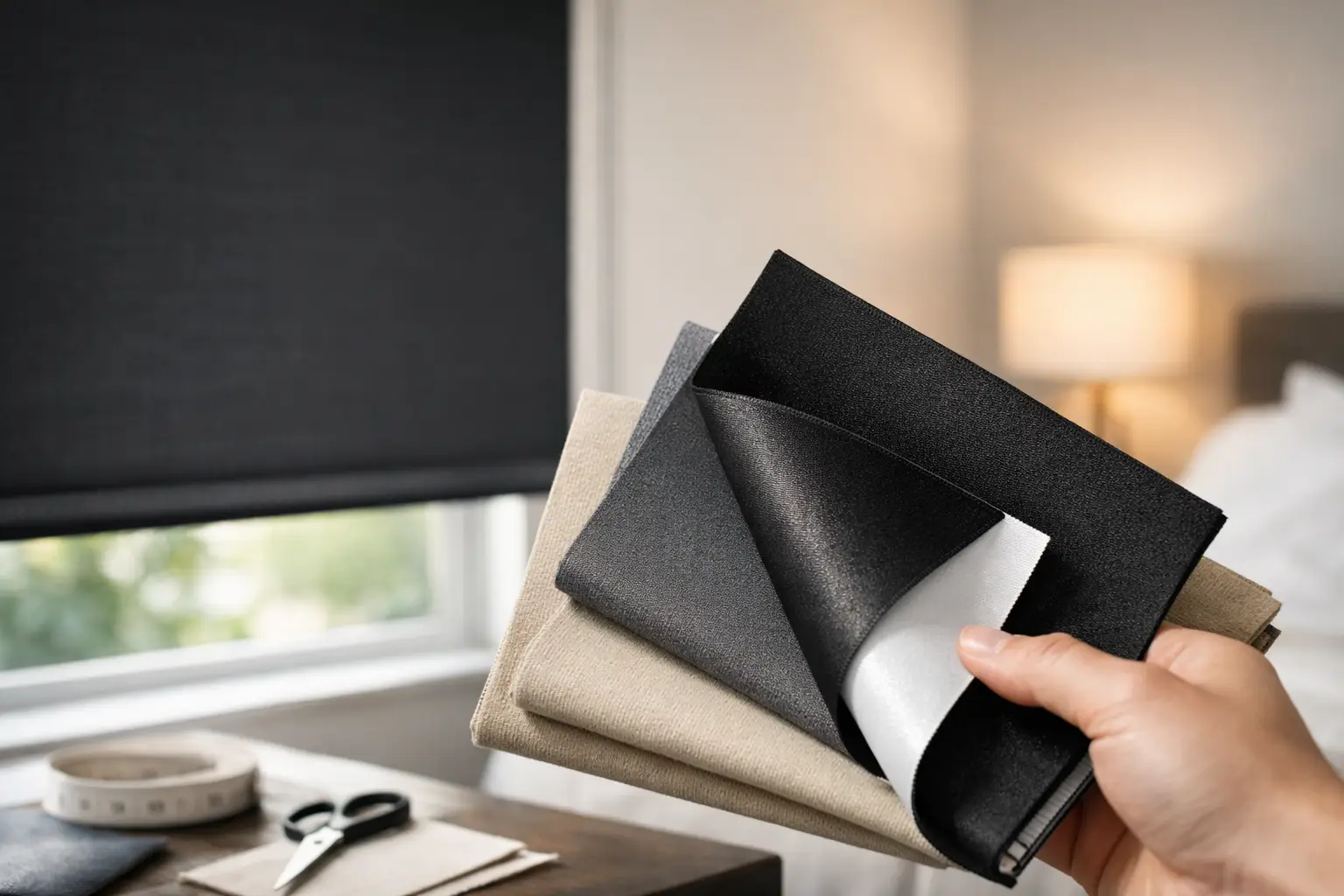
A blackout blind can make the difference between a child waking at first light and a properly restful morning, or between a bright south-facing office and a screen-friendly workspace. Knowing how to choose blackout fabric means looking beyond the word “blackout” on a sample. The fabric, blind style, window shape and fitting all affect how dark, private and comfortable the finished room will feel.
Start with what the room needs
Blackout fabric is designed to stop light travelling through the material itself. It is a practical choice for bedrooms, nurseries, home cinemas, shift workers’ rooms and spaces where privacy matters after dark. It can also reduce glare on televisions and computer screens, while helping to limit heat loss through the window.
However, blackout does not automatically mean complete darkness. Light can still enter around the edges of a blind, through the gap above it or around brackets. This is most noticeable early in the morning, when streetlights are close to the window, or in rooms with pale walls that reflect light.
Before choosing a fabric, think about the result you actually want. A main bedroom may need the greatest possible light control. A living room may benefit more from reduced glare and privacy without making the space feel heavily shaded all day. In a commercial setting, such as a meeting room or treatment room, the priority may be consistent privacy and a neat professional finish.
Understand what makes fabric blackout
Most blackout fabrics have a tightly woven face fabric combined with a light-blocking backing or coating. The backing is often white, cream or colour-matched, depending on the range. A white backing can help reflect sunlight and heat, which is useful in sunny rooms, while a colour-matched reverse may suit windows visible from outside where appearance is a consideration.
Do not judge performance by thickness alone. Some fabrics feel substantial but are only dim-out, meaning they soften daylight rather than stop it. Others are relatively slim yet provide excellent blackout performance because of their specialist backing. Ask to see a sample held against a bright window or light source, rather than relying on the fabric’s appearance on a small swatch.
It is also worth checking the fabric’s intended use. Blackout materials for blinds are made to roll, stack or hang correctly within their chosen system. Using the right fabric for the right blind helps it keep its shape and operate smoothly over time.
Choose the blind style before selecting the fabric
The best way to choose blackout fabric depends partly on the blind you plan to have. The same material can perform differently in a roller blind, vertical blind or a layered window treatment.
Roller blinds for the strongest light control
Roller blinds are often the most effective choice where darkness is the priority. The fabric sits as one continuous panel, so there are no slat gaps. For bedrooms and nurseries, a blackout roller blind fitted close to the recess can significantly reduce incoming light.
For an even darker result, consider a cassette and side-channel system where appropriate. These guide the blind fabric along the sides of the window and reduce the light leakage that a standard roller blind can leave at the edges. They are particularly useful for skylights, bi-fold doors and rooms where early daylight is a regular problem.
Vertical blinds for wide windows and doors
Blackout vertical blinds work well on large windows, patio doors and commercial spaces. They give flexible light control because the louvres can be tilted as well as drawn across. When closed, they offer privacy and reduce light effectively, but small lines of light may remain between individual louvres. For this reason, they are usually better for light reduction and privacy than for a room that needs near-total darkness.
Venetian blinds and layered solutions
Venetian blinds offer precise control over direction of light, but the slats naturally leave small gaps. They are not normally the first choice for a true blackout bedroom. That said, they can look excellent when paired with lined curtains, or when the key goal is adjustable privacy rather than darkness.
A layered approach can also be a sensible solution for larger bedrooms and lounges. A blackout roller blind behind curtains provides dependable performance, while the curtains add softness, warmth and a more decorative finish.
Think about the colour in daylight and at night
The colour of blackout fabric changes the look of the room, even though it does not necessarily change the amount of light blocked through the fabric. Deep charcoal, navy and black create a dramatic, contemporary look and can frame a window beautifully. They may also show dust more readily, particularly in busy family homes or near open windows.
Lighter shades such as stone, soft grey, beige and white are popular because they keep the room feeling open when the blind is raised. A blackout backing means they can still provide excellent darkness when lowered. They often suit smaller bedrooms, neutral interiors and rental properties where a broadly appealing finish is useful.
Order samples wherever possible and view them at different times of day. A warm grey may appear calm in morning light but cooler under LED lighting in the evening. Look at the fabric beside wall paint, flooring and furniture rather than in isolation. This simple step avoids a colour choice that feels right in a brochure but wrong in the room.
Consider heat, insulation and window direction
Blackout fabric can support a more comfortable indoor temperature, but its effect depends on the blind type, fit and window itself. A close-fitting blind creates a layer of still air between the fabric and glass, helping to reduce heat loss in winter. In summer, a reflective backing can help limit solar gain, especially at south- and west-facing windows.
If your room feels cold in winter, do not choose solely on the basis of blackout performance. Ask about fabrics and blind systems that also offer thermal benefits. For older properties around Coventry and the wider West Midlands, where windows may be larger or less efficient, this can make a noticeable difference to comfort.
Conversely, rooms that get very hot in the afternoon may need a fabric that manages glare and heat without turning the room into a dark space all day. A blackout blind can be raised when daylight is wanted, but a dim-out or solar-control option may be the better everyday choice for a kitchen, lounge or office.
Pay attention to fitting and edge gaps
Accurate measuring is one of the biggest factors in blackout performance. A blind fitted inside a recess needs enough width to cover the glass area while allowing the mechanism to operate safely. One fitted outside the recess should extend beyond the window on both sides to reduce edge gaps.
There is always a balance. A recess-fit roller blind gives a tidy, built-in look, but it may allow a slim line of light around the sides. An outside-recess blind can cover more of the surrounding wall and improve darkness, although it becomes a more visible design feature. The best option depends on the depth of the recess, handle positions, opening direction and how the room is used.
Professional measuring also identifies obstacles that are easy to miss, including window handles, trickle vents, radiators, tiles and uneven plaster. These details matter more with blackout blinds because even a small gap can be obvious when the rest of the room is dark.
Choose a finish that suits daily life
A fabric needs to work as well on a busy Tuesday morning as it does when first fitted. In children’s bedrooms, wipe-clean or easy-care blackout fabrics are a practical choice. In kitchens, avoid materials likely to sit close to steam, grease or frequent splashes unless they are designed for that environment. For offices, reception areas and rental properties, a durable neutral fabric is often the most versatile option.
If the blind will be opened and closed several times a day, consider the control method too. A chain-operated roller blind offers straightforward control, while motorised blinds are convenient for hard-to-reach windows, large installations and households that want a more streamlined routine. Child-safe control options should always be considered in homes with young children.
Do not rely on a small sample alone
Samples are essential, but they cannot show every aspect of the finished blind. Ask how the fabric will be made, where the roll direction will sit, how it will look when lowered, and whether the selected system has side gaps. If complete darkness is your aim, say so clearly from the start. This allows the recommendation to focus on both blackout fabric and the right installation method.
At Queen Blinds, a home appointment gives you the opportunity to compare fabrics against your own décor, discuss the room’s practical needs and have the window measured accurately before fitting. It removes much of the guesswork, particularly for awkward recesses, bay windows, doors and larger commercial spaces.
The right blackout fabric should feel like part of a well-planned room, not a compromise made for darkness. Choose one that suits your window, your décor and the way you live, then let careful measuring and fitting do the rest.