


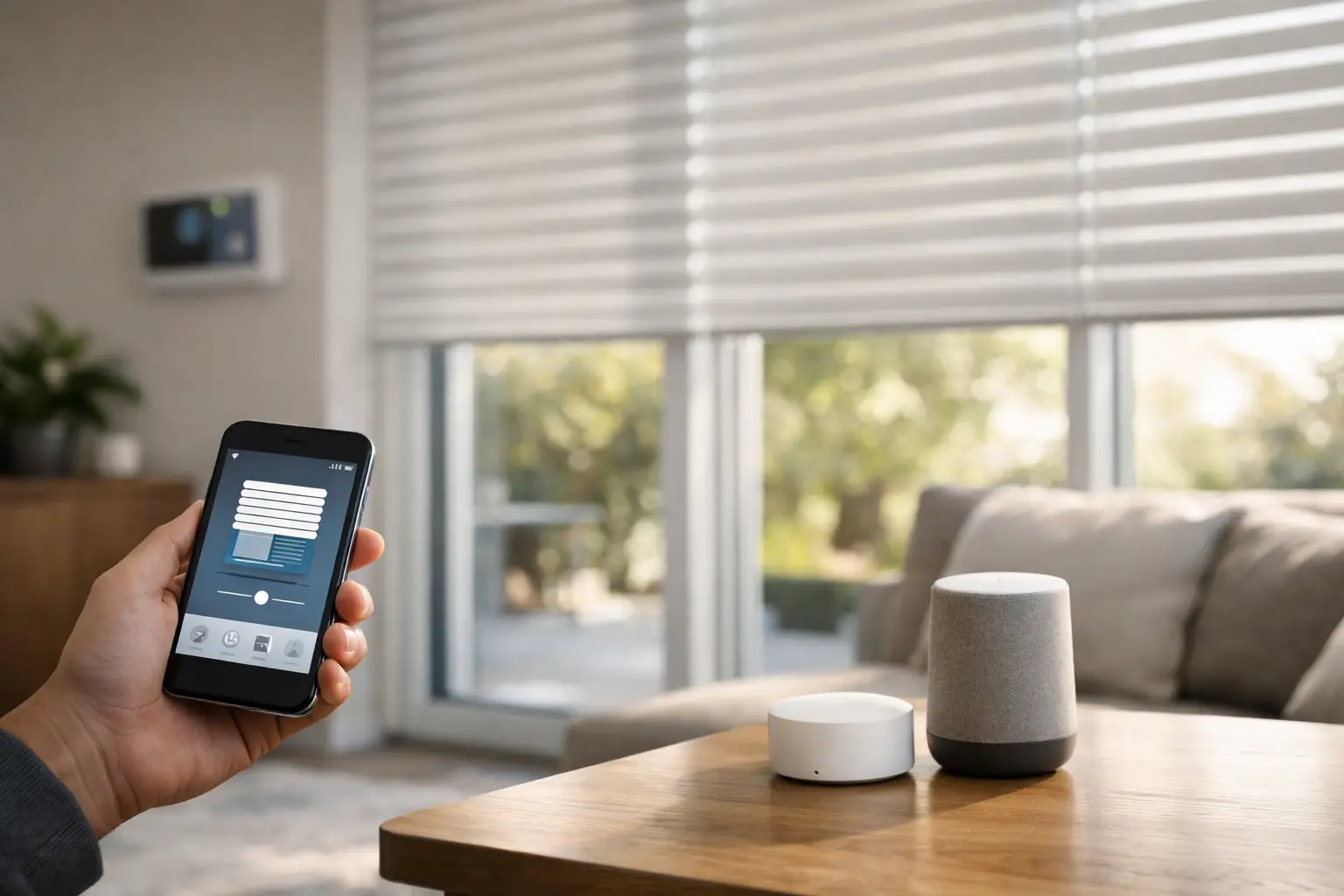
A bright Coventry morning can be lovely until the sun lands directly on a bedroom pillow, a home office screen or a conservatory sofa. Smart blinds home integration gives you a practical way to manage that light without walking from room to room, while keeping the made-to-measure finish that makes blinds look right in the first place.
Motorised blinds are not only for high-tech new builds. They can suit family homes, rental properties, renovated period houses and workplaces across the West Midlands. The best result comes from planning the controls, fabric and fitting around how you actually use each room.
What smart blinds home integration means
A smart blind has a motor that raises, lowers or tilts the blind without a traditional pull cord. Home integration means that motor can be controlled in more than one way: by a wall-mounted remote, a phone app, a timer, a voice assistant or an automated routine.
For example, you might set blackout blinds to close at bedtime, programme living room blinds to open with the morning alarm, or lower office blinds during the brightest part of the afternoon. These routines are useful, but they should support everyday comfort rather than add unnecessary complication.
The right set-up depends on the blind style and the room. Roller blinds are a popular choice for automated blackout and privacy control. Venetian blinds can offer more precise control of glare, while vertical blinds can work particularly well for wide windows and doors in offices, conservatories and larger living spaces.
Start with the control method
Before choosing fabrics or finishes, decide how you want to operate the blinds. A remote control is often the simplest option and suits households that want motorised convenience without relying on an app. App control can be useful when you are away from home, while voice control may appeal in kitchens, bedrooms or rooms with hard-to-reach windows.
Automation is most valuable when it is predictable. Timed routines are ideal for bedrooms and street-facing rooms where privacy matters. Light or temperature-based settings can be helpful in sun-facing spaces, but they need sensible programming. A blind closing too early on a winter afternoon may save a little glare control while removing useful natural light.
If you use a wider smart-home system, check compatibility before ordering. It is far easier to select a suitable motor at the planning stage than to assume every blind will connect to every platform afterwards.
Plan smart blinds home integration room by room
Treating every window the same is one of the most common mistakes. Each room has different demands for light, privacy, insulation and appearance, so its blind specification should reflect that.
Bedrooms and children’s rooms
Blackout roller blinds are an excellent starting point for bedrooms, particularly for shift workers, young children and anyone affected by early summer daylight. Motorisation lets you set a regular closing time without cords hanging near beds or cots.
Complete darkness depends on the fitting as well as the fabric. Light can still pass around the sides of a blind, especially in a recessed window. Accurate measuring and professional advice will help you decide whether an inside-recess or outside-recess fitting gives the best coverage.
Living rooms and conservatories
In living areas, the priority is often balancing daylight with comfort. A light-filtering fabric can soften glare without making the room feel closed in, while a dim-out or blackout option may suit television areas and south-facing conservatories.
Smart controls are particularly useful for large or awkward windows. Rather than leaving blinds open because they are difficult to reach, you can adjust them quickly as the sun moves. For homes with several blinds on one elevation, grouping them on one control can make the room easier to manage.
Kitchens and bathrooms
These rooms need materials that cope well with daily use, moisture and easy cleaning. A roller or Venetian-style blind may be more practical than a heavier fabric treatment, depending on the window position and ventilation.
Motorisation can be useful above kitchen worktops, sinks or bath areas where manual controls are inconvenient. The key consideration is safe, suitable positioning for the motor and power source. A professional survey will identify what is practical for the space.
Home offices and commercial spaces
Glare on screens is a daily frustration in home offices, salons, clinics and workplaces. Automated blinds can lower at set times to protect screens from direct sun, then open again when the light becomes softer.
For commercial properties, consistency matters as much as convenience. Matching made-to-measure blinds across meeting rooms, reception areas and offices creates a cleaner appearance, while centralised control can make opening and closing routines easier for staff.
Choose power with fitting in mind
Smart blinds are usually powered by a rechargeable battery, a mains supply or, in some cases, solar assistance. Each option has advantages, and there is no single right answer.
Rechargeable battery motors are often the least disruptive choice for existing homes. They avoid visible wiring and can be a sensible solution where electrical work is not planned. They do, however, need charging from time to time, particularly on larger or frequently used blinds.
Mains-powered blinds are well suited to renovations, extensions and new-build projects where cabling can be planned before decorating is finished. They offer dependable operation without battery charging, but installation needs to be considered early and carried out safely.
Solar-powered charging can reduce the need for manual recharging on suitable windows. It works best where the panel receives enough daylight, so it may not be appropriate for shaded, north-facing or heavily recessed windows.
A good survey considers more than the window width and drop. It should also look at the recess depth, handle clearance, nearby sockets, access for charging, Wi-Fi strength where relevant and the finished look of the blind. These details are what prevent a smart feature from becoming an everyday annoyance.
Do not overlook fabric performance
The motor controls the movement, but the fabric does the practical work. If a room overheats in direct sun, choose a fabric with appropriate light and UV control. If warmth is escaping through a large window, consider materials and blind designs that support insulation. If privacy is the concern, think about what the blind looks like from outside in the evening when indoor lights are on.
Colour also affects the feel of a room. Pale fabrics can keep a space bright and understated, while darker shades create a more defined finish and may be better suited to blackout requirements. Wooden-look composite Venetians can bring warmth and structure without the maintenance concerns associated with natural wood in higher-moisture areas.
For families, cordless motorised operation also removes the need for loose operating cords. That is a valuable child-safety benefit, but it should sit alongside sensible blind placement and proper fitting rather than being treated as the only safety measure.
Smart blinds are not always the answer
Motorisation adds cost, so it makes most sense where it solves a genuine problem. High windows, wide banks of glazing, difficult-to-reach areas, busy family routines and glare-heavy workspaces are strong candidates. A simple manual blind may still be the more economical and reliable choice for a small, easily reached window that is only adjusted occasionally.
It is also worth avoiding too many complicated routines. Most households get the best value from a few useful settings: wake-up, bedtime, away-from-home privacy and afternoon glare control. The technology should feel natural for everyone in the property, not depend on one person knowing how to operate it.
Why made-to-measure fitting matters
Smart blinds need more than an attractive fabric and a compatible motor. They need precise dimensions, secure brackets and enough clearance for the blind to operate properly. Poorly fitted blinds can sit unevenly, leave unwanted gaps or struggle around window handles and trims.
A local appointment gives you the chance to see colours and materials in your own light, discuss how each room is used and receive advice based on the window rather than an online measurement guess. Queen Blinds can help homeowners and commercial customers across Coventry and the wider West Midlands select made-to-measure options, measure accurately and arrange professional fitting.
Can smart blinds still be operated manually?
Most motorised blinds include a remote or app-based alternative to automation, so you are not restricted to a schedule. The exact operation depends on the motor and control system selected, which is why it is worth discussing everyday use before installation.
Will smart blinds work during a power cut?
Battery-operated systems can usually continue to operate while charged. Mains-powered blinds may not function during an outage unless the system has a suitable backup arrangement. This is a useful question to raise when comparing power options.
Are smart blinds suitable for older homes?
Yes, provided the window and power arrangement are assessed properly. Battery-operated motors can be especially practical in older properties where adding new wiring would be disruptive.
The most satisfying smart-blind set-up is usually the quietest one: blinds that open when you want daylight, close when you need privacy, and fit the room so well that you stop thinking about the mechanism at all.