


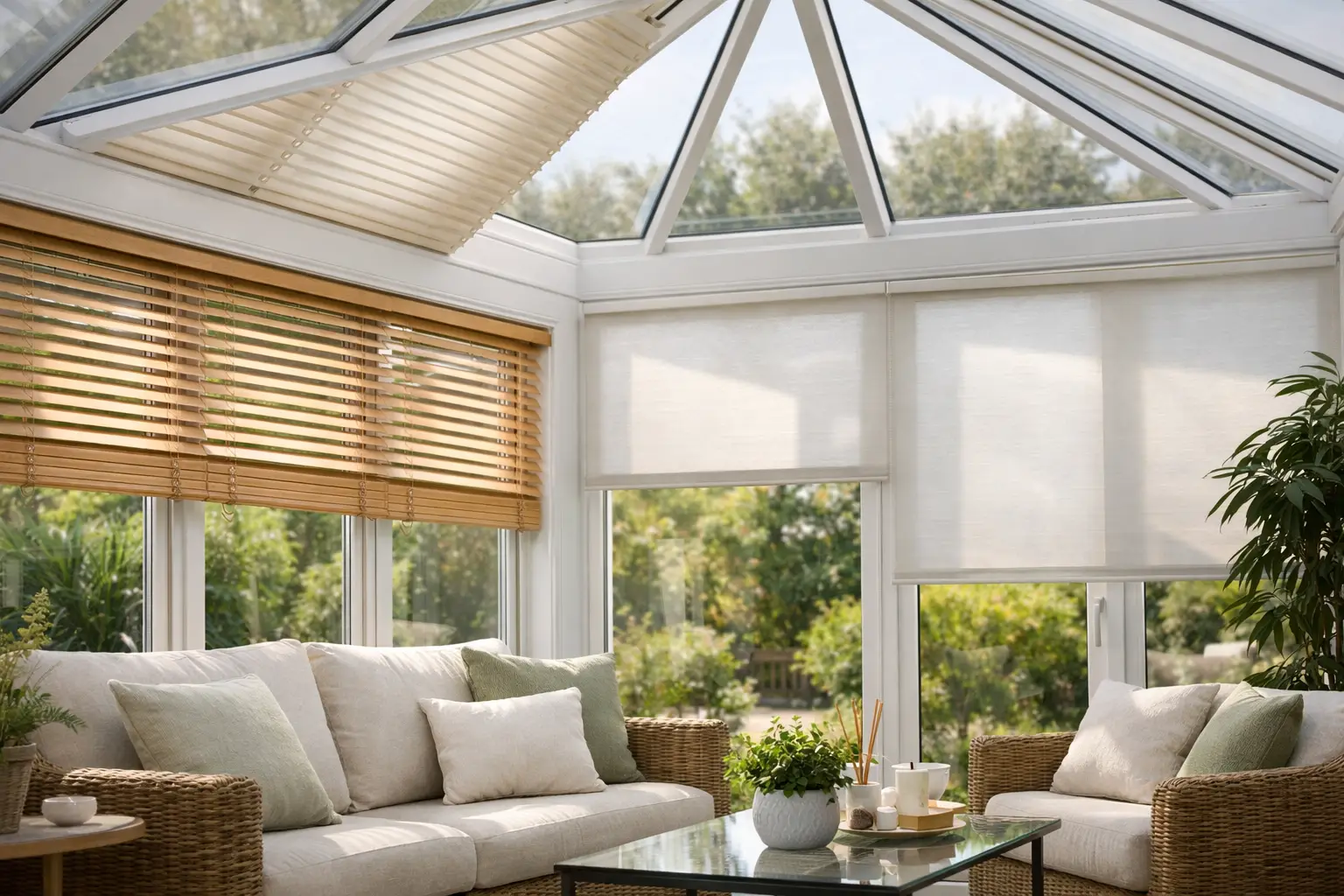
A conservatory can be the brightest room in the house and the hardest to keep comfortable. Too much glare on sunny afternoons, a lack of privacy in the evening, and temperature swings through the seasons all make blinds for conservatory windows less of a finishing touch and more of a practical upgrade.
The right blind does several jobs at once. It softens harsh light, helps manage heat, adds privacy, and gives the room a more polished look. The challenge is that conservatories are rarely straightforward. You might be dealing with tall panes, awkward angles, roof sections, doors that open regularly, or a mix of materials and frame colours. That is why made-to-measure advice matters here more than it does in a standard lounge or bedroom.
Why conservatory windows need a different approach
Conservatories take more direct sunlight than most rooms, and that changes what you need from a blind. In summer, the space can become uncomfortably warm. In winter, glass-heavy rooms tend to lose heat faster. Standard off-the-shelf options often leave gaps, sit poorly against the frame, or simply do not stand up to daily use in a high-light, high-temperature space.
Good blinds for conservatory windows should be chosen with performance in mind first, then style. That means thinking about insulation, glare reduction, UV protection and easy operation before settling on a fabric or finish. A blind that looks right but cannot cope with strong sun or awkward window shapes will quickly feel like the wrong choice.
It also depends on how you use the room. A conservatory used as a dining area needs a different balance of light and privacy than one used as a home office or playroom. If it is a space where children spend time, safety features matter too, especially when several blinds are being fitted across one room.
The best types of blinds for conservatory windows
There is no single best option for every conservatory, but some styles consistently work better than others.
Roller blinds for a clean, practical finish
Roller blinds are a popular choice because they are neat, simple to operate and available in a wide range of fabrics. They suit modern conservatories particularly well and can be tailored to match the rest of the home rather than making the room feel separate.
If glare or excess heat is the main problem, solar-reflective or UV-protective fabrics are worth considering. If the room gets heavy sun during the day, a dim-out or blackout fabric can make the space far more usable. Not every conservatory needs blackout blinds, but they can be a sensible choice for roof sections or rooms that double as a TV area.
Roller blinds are also one of the easiest options to keep looking smart. For busy households, that low-maintenance quality is a real advantage.
Venetian blinds for flexible light control
Venetian blinds give you more precise control over light than many fabric styles. You can tilt the slats to cut glare while still letting daylight in, which is useful if the conservatory is used throughout the day.
Aluminium Venetian blinds work well in bright spaces, but many customers prefer wood-look composite finishes for a softer appearance. Composite slats can be particularly practical where durability matters, as they offer the visual warmth of wood with less day-to-day worry. If your conservatory connects directly to a kitchen or family room, that balance of style and resilience can be a strong selling point.
The trade-off is that Venetian blinds usually take a little more cleaning than a roller blind. In a conservatory, where dust and sunlight tend to highlight everything, that is worth bearing in mind.
Vertical blinds for larger glazed sections
Vertical blinds are especially useful for wide conservatory windows and doors. They are easy to adjust, simple to draw back, and effective at controlling both privacy and sunlight across broad sections of glass.
For homeowners with older conservatories or rooms with patio-style access, vertical blinds often offer a practical fit without making the room feel crowded. They can also work well in commercial settings such as waiting areas, offices or showroom-style spaces where a tidy, professional appearance matters.
Fabric choice is important here. Lighter colours can keep the room feeling open, while performance fabrics can help reduce glare and fading from direct sun.
Roof blinds and side blinds need to work together
One of the most common mistakes in conservatory design is treating the side windows as the only issue. In reality, roof glazing often causes the biggest problems with heat and glare. If the roof is left uncovered, the room may still feel too bright or too hot even after the side windows are dressed properly.
That does not always mean every pane needs a blind. Sometimes the best result comes from targeting the areas that take the most sun and combining that with side blinds that improve privacy and balance the look of the room. A tailored approach usually gives a better result than trying to apply one style everywhere without considering how the space actually behaves.
This is where expert measuring and product guidance make a clear difference. Conservatories rarely follow a standard pattern, and small fitting inaccuracies become very obvious across multiple panes.
Choosing the right fabric or finish
When customers think about blinds, they often start with colour. In a conservatory, fabric performance should come first. The right material can help moderate temperature, protect furniture from UV fading and make the room more comfortable throughout the year.
Insulating fabrics are useful if the room feels cold in winter. Reflective backings can help in sunny spots. Moisture-resistant and wipe-clean options are practical if the conservatory opens into a garden and sees regular foot traffic, pets or family use.
Colour still matters, of course. Pale tones keep the room feeling bright and spacious, while darker shades can add contrast and stronger light control. Neutral finishes tend to age well, especially if you may update furniture or flooring later. If the conservatory is part of an open-plan ground floor, matching the blinds to nearby rooms usually creates a more considered result than treating it as a standalone space.
Motorised blinds make everyday use easier
A conservatory often has more windows than any other room in the house. That means a blind choice that seems manageable on one or two windows can become less convenient when repeated across ten or more sections.
Motorised operation is worth serious thought, particularly for hard-to-reach windows or roof blinds. It makes day-to-day adjustment much easier and encourages you to use the blinds properly rather than leaving them open because it is a hassle to reach them. For family homes, it can also help with child safety by reducing or removing the need for cords.
This is one of those upgrades that sounds like a luxury until you live with it. In larger conservatories, it quickly becomes a practical feature.
Why made-to-measure matters more in a conservatory
Conservatory windows expose every fitting issue. A small gap at the edge of a blind can let in a surprising amount of light. A blind that sits awkwardly against the frame can spoil the overall finish of the room. On doors and angled sections, poor measuring often leads to frustration from the start.
Made-to-measure blinds solve that by being designed around the actual structure rather than an assumed size. They also give you more control over details such as fabric type, operation, finish and how each blind works alongside the next. If your aim is a room that feels comfortable, coordinated and easy to use, accurate measuring is not an extra. It is the foundation.
That is why many homeowners across Coventry and the wider West Midlands prefer a service that includes consultation, measuring and fitting. It removes guesswork and gives you tailored recommendations based on how the room is used, not just what looks good in a sample book.
What to consider before you choose blinds for conservatory windows
Before settling on a style, it helps to be clear about the main problem you are trying to solve. If overheating is the issue, focus on thermal and reflective performance. If overlooked glazing is the concern, think about privacy at eye level and how the room is used in the evening. If you want a neater, more finished appearance, consider how the blinds will sit with adjoining rooms and frame colours.
It is also worth thinking seasonally. A conservatory that feels pleasant in spring can become difficult in peak summer or noticeably colder in January. The best blinds for conservatory windows are the ones that improve the room all year, not just for one part of it.
For many properties, the right answer is a combination of style, fabric and expert fitting rather than one headline feature. Queen Blinds often helps customers narrow that down during a home appointment, where it is much easier to assess the light, layout and practical demands of the space.
A conservatory should feel like an extension of your home, not a room you avoid when the weather changes. The right blinds can make that happen quietly, by turning a bright but awkward space into one that works properly every day.