


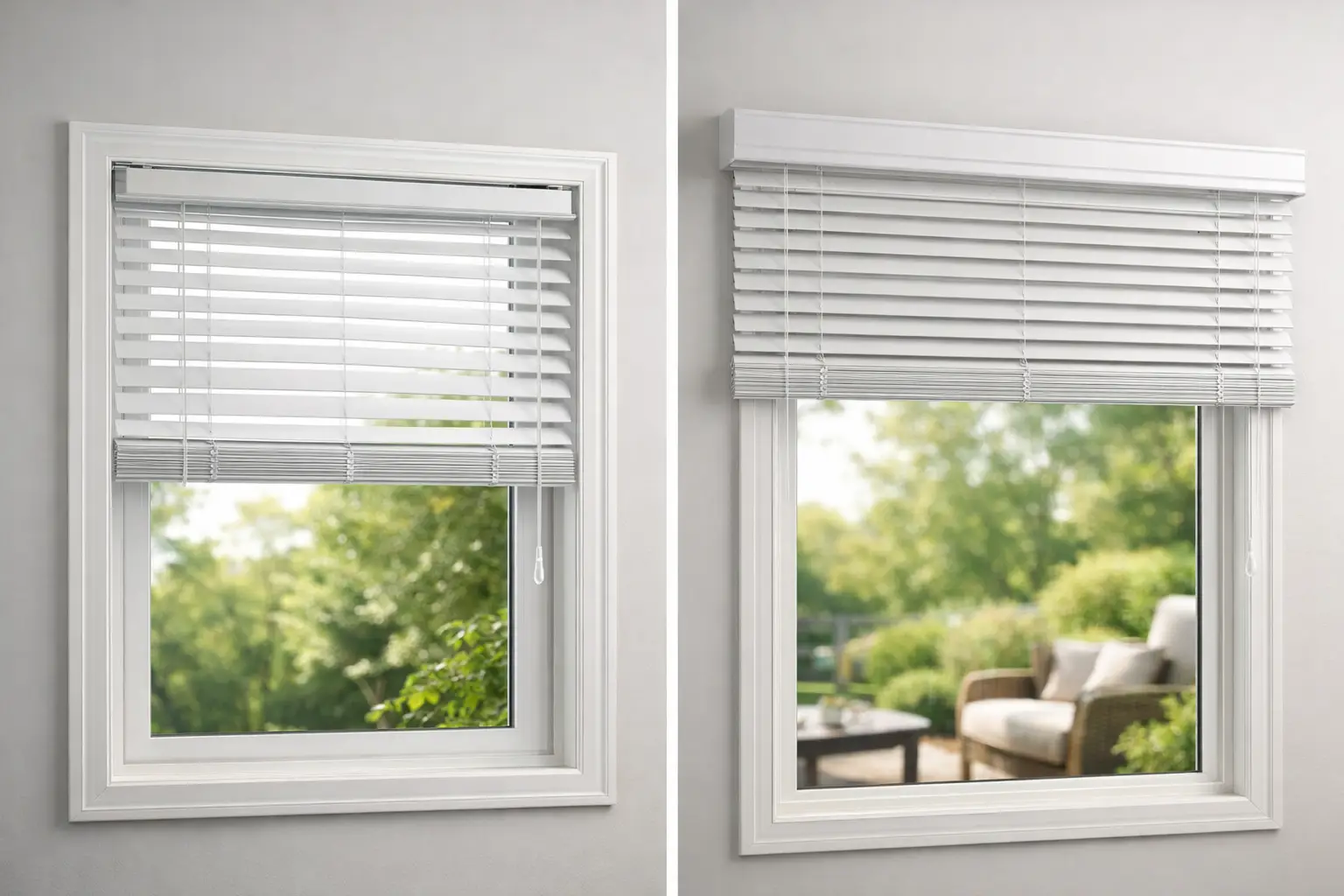
When choosing blinds, the inside mount vs outside mount decision has more impact than many people expect. It affects how neat the finished window looks, how much light gets through the edges, and even whether a particular blind style will work at all. Get this part right and the whole room feels more considered. Get it wrong and even a good-quality blind can look awkward.
For most homeowners and business clients, this is not really about jargon. It is about what will look best, perform properly and fit the way the room is used. That is why the right answer is rarely one-size-fits-all. It depends on your window depth, your wall space, your need for blackout or privacy, and the overall look you want to achieve.
Inside mount vs outside mount: what is the difference?
An inside mount blind fits within the window recess. It sits neatly inside the frame, which creates a clean, built-in appearance. This is often the look people picture when they want something minimal and tidy.
An outside mount blind is fixed outside the recess, either above the window opening or across the surrounding wall or architrave. This allows the blind to cover more area than the recess itself. It can make a window appear larger and gives more flexibility when the recess is shallow or uneven.
Neither option is automatically better. The best choice comes from the window itself and what you need the blind to do day to day.
Why inside mount blinds appeal to so many people
Inside mount blinds are popular because they look smart and understated. They let the shape of the window remain visible, which works especially well in modern homes, bay windows and offices where a neat finish matters. If you like a tailored look that sits close to the glass, this style is usually the natural choice.
They also take up less visual space in the room. In smaller rooms, that can help everything feel less crowded. Venetian blinds and roller blinds often suit an inside mount very well, provided the recess has enough depth for the mechanism and the blind can operate freely.
There is, however, a practical trade-off. Because the blind sits inside the recess, a small gap usually remains around the edges. That may not matter in a kitchen, dining area or office, but it can matter in bedrooms, nurseries or media rooms where better blackout is the priority. Even a made-to-measure blind will usually allow some light around the sides if it is recess fitted.
When outside mount blinds make more sense
Outside mount blinds are often the better option when function comes first. By extending beyond the window opening, they can reduce light bleed around the edges and improve privacy. That makes them a strong choice for bedrooms, children’s rooms and any space where stronger light control is needed.
They can also solve awkward fitting problems. If the recess is too shallow, if handles project into the opening, or if the window is not perfectly square, fitting outside the recess often avoids compromise. This is especially useful in older properties where walls and frames are not always consistent.
Visually, outside mount blinds can be used to make a window feel bigger and more balanced. In commercial spaces, that can help create a cleaner, more uniform appearance across multiple windows. In homes, it can soften a small window and give it more presence.
Light control and blackout performance
If your main concern is keeping light out, outside mount usually has the advantage. Because the blind overlaps the opening, there is less space for daylight to creep in. That is why many blackout installations work best this way, particularly in bedrooms.
Inside mount blinds can still offer very good shading, but they are rarely the strongest option for full blackout on their own. If you want a recess fit for the look, you may need to accept some light leakage or pair the blind with curtains for better coverage.
This is one of the clearest examples of style versus performance. The cleaner look of an inside mount is attractive, but for sleep, shift work or home cinema use, outside mount can be the more practical answer.
Measuring matters more than most people realise
The inside mount vs outside mount choice also changes how the blind must be measured. An inside mount depends on accurate recess measurements and enough depth to accommodate the blind mechanism. Even a small measuring error can affect how smoothly the blind operates or how evenly it sits.
Outside mount measuring is more flexible, but it still needs thought. The blind should usually extend beyond the opening to improve coverage and create a balanced look. If the width or drop is misjudged, the result can look mean or poorly proportioned.
This is where expert advice makes a real difference. A professional measure does not just capture dimensions. It also takes account of handles, tiles, skirting detail, shallow recesses and the practical clearance needed for the blind to work properly.
Which blind styles work best with each option?
Many blind types can be fitted either inside or outside the recess, but some combinations are more successful than others.
Roller blinds are versatile and work well in both positions. Inside the recess, they look crisp and simple. Outside the recess, they offer stronger blackout and broader coverage.
Venetian blinds are often chosen for inside mounts because their structured lines suit a neat recess fit. They can still be fitted outside, particularly if the recess is too shallow, but the look is generally a little more prominent.
Vertical blinds are frequently used as outside mounts for larger windows and patio doors, although they can also sit within a suitable recess. In offices and commercial settings, outside fitting often helps with coverage and operation.
For each style, the right answer depends on the room and the window rather than a fixed rule.
Room-by-room considerations
In bedrooms, outside mount blinds often come out ahead because blackout and privacy usually matter more than showing off the window frame. In living rooms, it is more balanced. If the room benefits from a clean architectural look, inside mount can be ideal. If the window is small or you want better coverage, outside mount may be more effective.
In kitchens and bathrooms, moisture-resistant materials and ease of cleaning often matter more than mount position alone. Inside mount can look tidy, but only if the recess allows enough space and the blind is clear of splashes, taps or obstructions.
For offices, clinics and other workplaces, consistency is often key. If you have several windows of slightly different depths, outside mount can help create a more uniform finish across the room.
What about window features and awkward spaces?
Not every window is straightforward. Deep recesses tend to suit inside mounts well, but projecting handles, vents, tiles and uneven plaster can all change the decision. Bay windows, for example, often look excellent with recess-fitted blinds, though each section must be measured carefully. French doors and patio doors may suit outside mount blinds if handle clearance is an issue.
Older homes across the West Midlands often present exactly these kinds of details. A solution that looks simple from across the room can involve several practical fitting decisions up close. That is why a tailored recommendation usually delivers a better result than guessing based on photos alone.
So which should you choose?
Choose inside mount if you want a fitted, streamlined look and your recess is deep enough, square enough and free from obstructions. It is especially well suited to spaces where appearance and simplicity lead the decision.
Choose outside mount if you want better blackout, more privacy, greater flexibility or a way to handle a difficult recess. It is often the safer option when the window opening is shallow, uneven or visually underwhelming.
For many customers, the best decision comes down to one simple question: do you want the blind to sit neatly within the window, or do you want it to dominate the opening and perform more aggressively? Both approaches can look excellent when they are chosen for the right reasons.
At Queen Blinds, this is exactly the kind of detail that is easier to sort out during a home visit than from a tape measure and a product photo. The right mount should feel obvious once the window, room and blind style are considered together.
A well-fitted blind should not leave you thinking about what you should have chosen. It should simply look right, work properly and make the room more comfortable every day.