


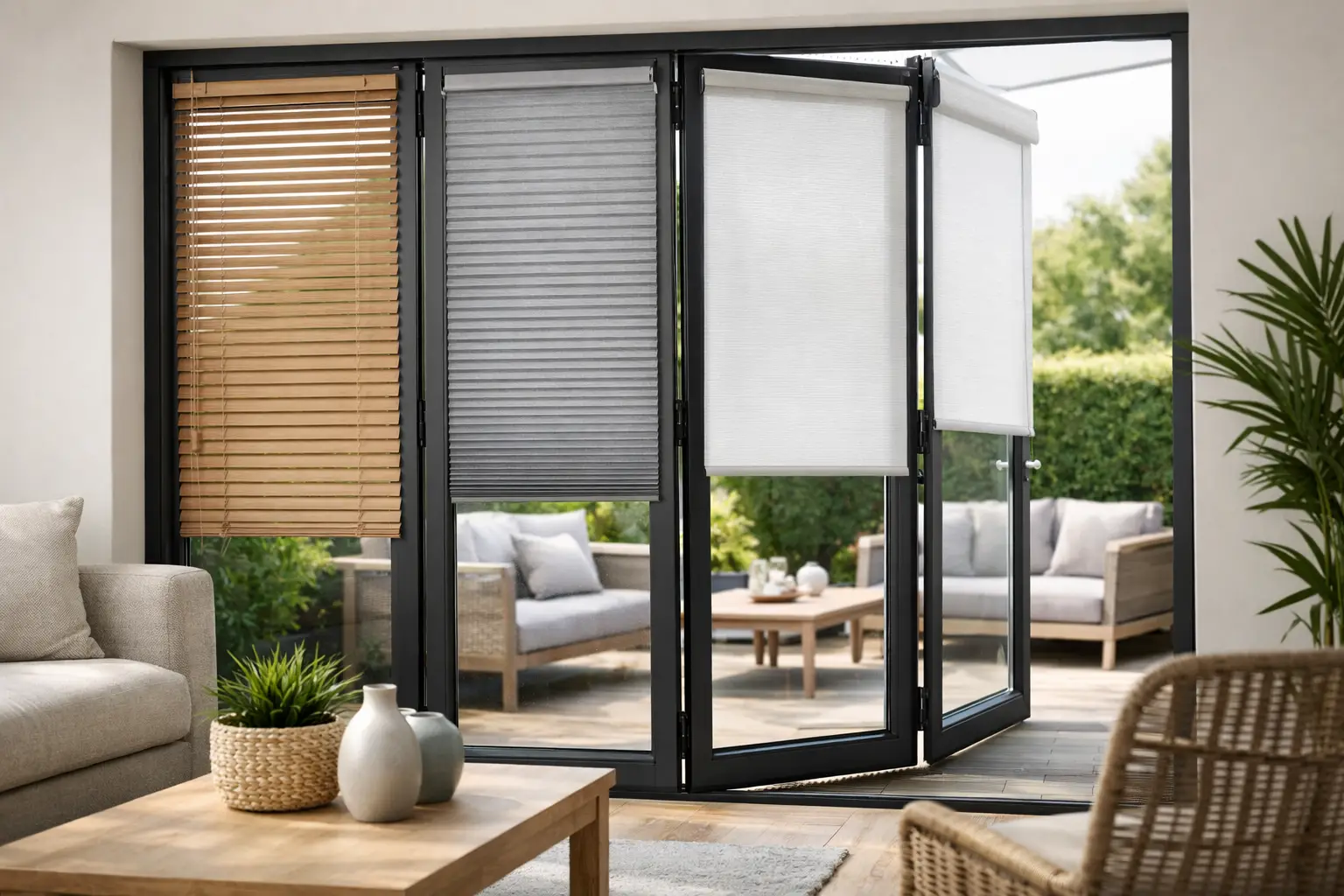
Bifold doors look brilliant when they are open and filling a room with light. The tricky part comes later, when glare hits the television, the room starts overheating, or you realise the neighbours have a perfect view indoors. Choosing the best blinds for bifold doors is really about getting the balance right between light control, privacy, easy access and a neat finish.
Unlike a standard window, bifold doors are busy. They fold, stack and get used constantly, especially in kitchens, extensions and open-plan living spaces. That means a blind has to do more than just look good. It needs to work with the doors, not against them.
What makes bifold doors harder to dress?
The main issue is movement. Bifold doors have multiple panels, handles that project, and frames that need clearance when the doors fold back. A blind that suits a fixed window can quickly become frustrating on bifolds if it catches on handles, blocks access or feels awkward every time you step outside.
There is also the question of how you use the space. Some people want full privacy in the evening but clear views during the day. Others are more concerned about reducing heat and glare in south-facing rooms. In commercial settings, the priority may be a smart appearance that is easy to maintain. That is why there is no single answer for every property, even when people ask for the best blinds for bifold doors.
Best blinds for bifold doors: the top options
Perfect fit blinds
For many homes, perfect fit blinds are one of the most practical choices. These blinds sit neatly within a frame that clips to the door, so there is no drilling into the uPVC and no loose fabric swinging around when the doors move. Because they move with each panel, they are especially useful if you want to open and close the doors regularly without having to raise the blinds each time.
They work well for privacy and light control, and they keep a tidy, fitted look that suits modern bifolds. They are particularly popular in kitchens, dining spaces and family rooms where convenience matters as much as appearance.
There are a couple of trade-offs. Perfect fit systems depend on the door style and bead depth, so they are not suitable for every installation. They also give a more fitted, functional look than a soft, full-width window treatment. If you like a crisp, streamlined finish, that is a strength rather than a drawback.
Integral or pleated blinds
Pleated blinds, including systems designed to sit close to the glass, are another strong option for bifold doors. Their slim profile helps reduce bulk, which is helpful where handles and door operation can get in the way. They also soften the look of large glazed areas without making the room feel heavy.
This style is often chosen when homeowners want a contemporary finish and flexible shading. Depending on the fabric, pleated blinds can also help with insulation, which is useful in rooms that get cold in winter and overly warm in summer.
The key here is fabric choice. A light-filtering fabric will keep the room bright while reducing glare, whereas a blackout option gives more privacy and stronger sun control. In many bifold spaces, light filtering is the better all-round choice because full blackout can feel too heavy for daytime use.
Roller blinds
Roller blinds are one of the simplest and most versatile solutions, especially when fitted above the full door span rather than on each panel. They suit bifold doors when you want a clean, modern look and straightforward operation. With the right fabric, they can provide anything from soft filtered light to near blackout coverage.
They are especially useful on wider openings where individual blinds on each panel may feel too fussy. A single or split roller setup above the doors can create a polished finish and work well in both homes and commercial spaces.
That said, roller blinds are better suited to rooms where the doors are not being folded back and forth all day long. If the blind is lowered, access to the doors is limited until it is raised. For some households, that is not a problem. For others, especially in summer when the garden door is in constant use, it can become inconvenient.
Venetian blinds
Venetian blinds can work well on bifold doors if you want precise control over light and privacy. Tilting the slats lets you reduce glare without closing off the room completely, which is useful in offices, dining areas and south-facing extensions.
Aluminium Venetian blinds offer a sleek, contemporary look, while wooden-look composite options bring warmth without the maintenance concerns of real wood in humid rooms. They are practical, easy to wipe clean and available in finishes that suit both residential and commercial interiors.
The point to watch is movement. Traditional Venetian blinds can swing if fixed directly to frequently used doors, and slats can rattle more than other styles. They are often better on adjacent windows or on bifolds that are used less often, rather than on the busiest family back door.
Vertical blinds
Vertical blinds are sometimes overlooked for bifold doors because people associate them with offices, but they can be a sensible choice for large glazed openings. They offer very good light control, slide neatly to the side and suit wider spans where other blind types may become costly or impractical.
Modern fabrics and finishes have improved their appearance considerably, so they are no longer limited to strictly commercial interiors. In the right room, they can look smart and understated.
They are most suitable when the doors are often shut and you want flexible coverage across a broad opening. They are less ideal if you want a fitted look on each panel or if you strongly prefer a softer, more decorative finish.
How to choose the right option for your space
The best choice depends on how the doors are used day to day. If you open them regularly and want the blind to move with the panels, fitted systems such as perfect fit or certain pleated options are usually the most convenient. If your priority is covering a large opening neatly, roller or vertical blinds may make more sense.
Room orientation matters too. In a south- or west-facing room, glare and heat gain are often bigger concerns than privacy alone. Fabrics with solar control, UV protection or thermal performance can make the room more comfortable while also helping protect flooring and furniture from fading.
For family homes, child safety should also be part of the decision. Neat, tensioned or integrated systems can reduce dangling cords and make the area around doors feel safer and less cluttered.
Then there is the finish. Bifold doors are usually a design feature, so the blind should complement them rather than dominate them. Neutral tones, clean lines and made-to-measure fitting tend to work best, especially in modern extensions and open-plan layouts.
Why made-to-measure matters with bifold doors
Bifold doors are far less forgiving than ordinary windows. Small measuring errors can lead to blinds catching on handles, sitting unevenly or leaving awkward gaps that affect privacy. This is one area where a made-to-measure approach makes a real difference.
Professional measuring helps account for frame depth, handle clearance, stacking direction and how far the doors project when opened. Those details can be easy to miss if you are trying to judge everything from a tape measure alone.
A tailored recommendation is just as important as the product itself. A blind that looks right online may not be the best fit once the practical realities of the room are considered. That is why many customers prefer a full service that includes measuring, advice and fitting, rather than guessing and hoping for the best.
Are motorised blinds a good idea for bifold doors?
They can be, particularly for larger openings or high-use rooms. Motorised roller blinds above bifold doors give a very clean finish and make it easier to control light without walking across the room every time. They are also useful in commercial settings where convenience and a polished appearance both matter.
However, motorisation is not automatically the best option for every bifold setup. If the doors are being opened constantly and you need panel-by-panel flexibility, a clipped or fitted system may still be more practical. Motorisation makes most sense where the blind covers the whole opening and is used mainly for scheduled shading, privacy in the evening or reducing glare.
The best blinds for bifold doors in modern homes
In most modern homes, the strongest all-round choices are perfect fit blinds, slim pleated systems and well-specified roller blinds. Each offers a different balance of convenience, appearance and control. The right answer comes down to whether you value daily access, a minimal look, stronger shading or a softer effect across a large glazed area.
For homeowners and businesses across Coventry and the West Midlands, this is usually a decision worth getting right first time. A well-fitted blind makes bifold doors feel more comfortable, more private and easier to live with throughout the year. If you are unsure, the smartest next step is not to guess between styles but to have the space assessed properly and choose a solution that fits the doors, the room and the way you actually use them.