


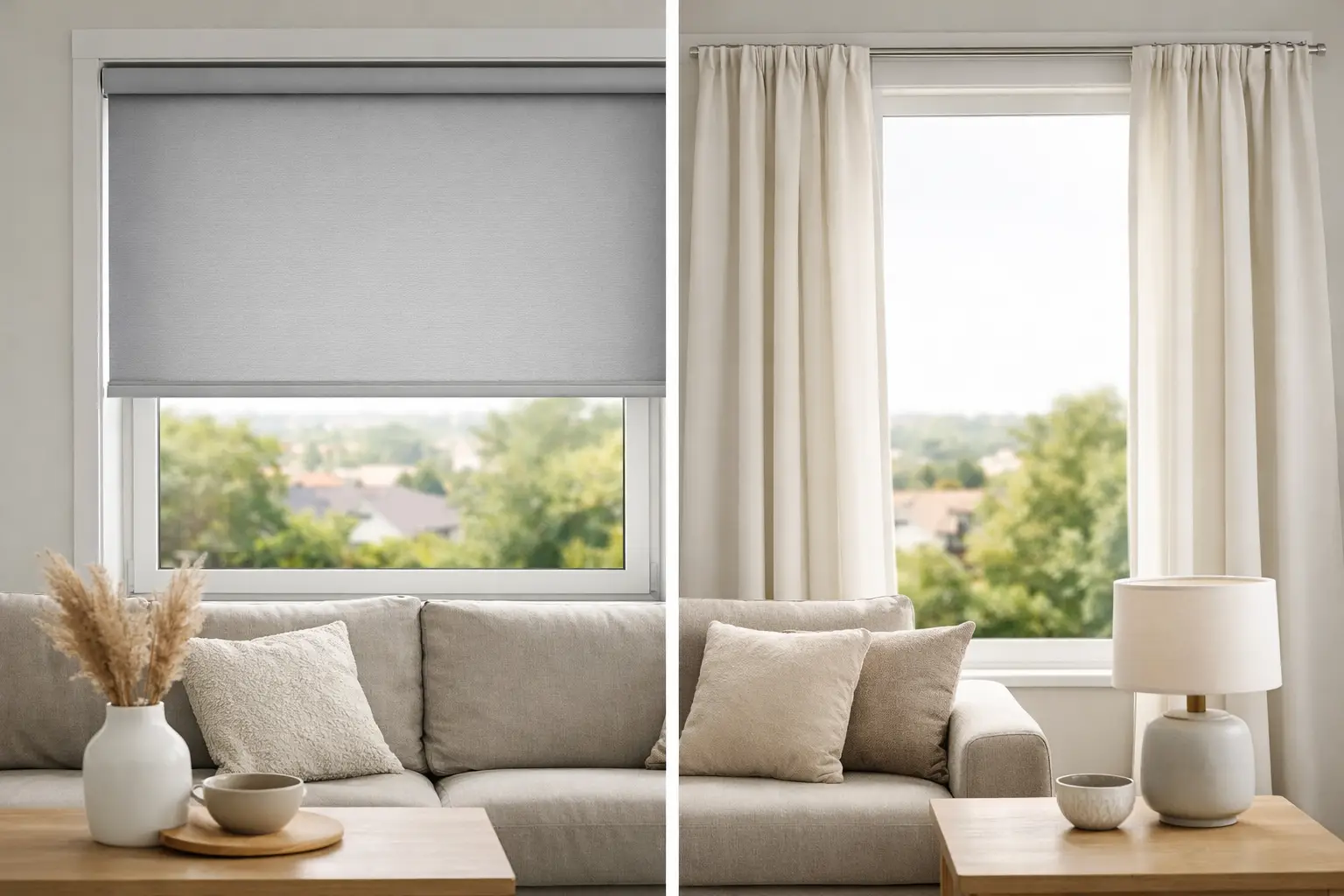
Stand in any room that does not quite feel finished and the window is usually the reason. When people ask whether to choose roller blinds or curtains, they are rarely comparing fabrics alone. They are deciding how they want the room to feel, how much light they need to control, and how much daily maintenance they are willing to take on.
There is no single right answer for every home or business. A bay window in a period property will ask for something different from a compact bathroom, a busy office or a child’s bedroom. The best choice depends on the window itself, the room’s purpose and how you want the space to work every day.
Roller blinds or curtains: what changes room to room?
The biggest difference is practical before it is visual. Curtains soften a space and can make a room feel warmer and more traditional. Roller blinds sit closer to the glass, give a cleaner line and suit people who want a neater, less bulky finish.
That sounds simple, but each option affects how a room performs. If you need blackout control in a bedroom, glare reduction in a workspace or a low-maintenance finish in a kitchen, blinds often have the edge. If your priority is softness, decorative impact and a fuller dressed-window look, curtains can be the better fit.
This is why a quick online comparison only goes so far. The same customer who prefers curtains in a lounge may choose roller blinds in a bathroom and office without hesitation.
Light control and privacy
Light control is often where roller blinds pull ahead. Because they are made to fit the window more closely, they offer a more precise way to manage daylight. This is especially useful in bedrooms, media rooms and offices where glare can be a genuine nuisance rather than a minor annoyance.
Blackout roller blinds are a strong option where sleep, screen use or shift patterns matter. They help reduce incoming light far more effectively than lightweight curtains, particularly if the window needs a close fit. In bathrooms and street-facing rooms, privacy fabrics can also give a clean balance between screening the room and keeping the space bright.
Curtains can still perform well here, particularly if they are lined and properly fitted. Heavy curtains can darken a room and add privacy, but they usually leave more room for light to spill around the edges. For some households that does not matter. For others, especially in bedrooms, it matters every morning.
Style and the overall look
Curtains make more of a statement. They introduce texture, fullness and movement, and they can help a room feel layered and finished. In traditional interiors, large lounges and formal dining spaces, that decorative weight can be exactly what is needed.
Roller blinds are more understated, which is often their strength. They suit modern homes, renovated spaces and commercial interiors because they look tidy and intentional without competing with the rest of the room. If you have patterned walls, bold furniture or a minimal scheme, roller blinds often complement the space rather than dominate it.
There is also a question of scale. In smaller rooms, curtains can feel heavy if the space is tight or the window is not large. A made-to-measure roller blind keeps the window area crisp and can make the room feel less crowded. In larger rooms, curtains can add the softness needed to stop the space feeling stark.
Upkeep and day-to-day living
This is where many people decide faster than they expect. Curtains need more ongoing care. They attract dust, hold onto odours more easily and are generally more awkward to remove, clean and rehang. In households with children, pets or allergies, that can become frustrating.
Roller blinds are usually easier to live with. A wipe-down fabric or moisture-resistant finish is practical in kitchens, bathrooms and high-traffic spaces. If your priority is a straightforward solution that looks smart without demanding much attention, blinds make daily life easier.
For landlords and commercial clients, this can be a deciding factor. A window covering that is simple to maintain and built around function often makes more sense than one that needs more care between tenancies or in busy work environments.
Warmth, insulation and comfort
People often assume curtains are always better for insulation. Sometimes they are, particularly if they are thick, lined and full-length. They can help reduce draughts and add a sense of warmth, especially in older properties with larger windows.
But well-made roller blinds should not be dismissed here. Depending on the fabric and construction, they can contribute to thermal performance and help reduce heat gain in summer as well as heat loss in colder months. If fitted properly to the window, they can be an efficient and space-saving option.
The important point is that insulation is not just about choosing curtains over blinds. It is about choosing the right material, the right fit and the right solution for the room. A poorly fitted curtain will not outperform a well-specified blind simply because it uses more fabric.
Safety and convenience
For family homes, safety matters. Any window covering needs to be considered carefully where young children are present. Modern blind systems can be specified with child-safe features, and that makes a real difference for households that want peace of mind without compromising on style.
Convenience also comes into play. Roller blinds are quick to operate, easy to adjust through the day and can be ideal for hard-to-reach windows. Motorised options are particularly useful in larger homes, offices and rooms where regular manual adjustment is inconvenient.
Curtains can still be simple to use, but they are not always as practical for awkward window layouts or everyday light changes. If you open and close your window covering several times a day, a roller blind often feels easier and more efficient.
Cost now and value over time
Price is rarely about the headline figure alone. Ready-made curtains may look affordable at first, but once you factor in poles, linings, alterations and the chance that they still do not hang quite right, the value equation changes.
Roller blinds can offer strong value because they are practical, long-lasting and made for the specific opening when measured properly. They also tend to suit a wider range of rooms, which makes them a consistent choice across an entire property.
That said, if the room needs decorative softness more than precision light control, curtains may still be worth the investment. The better question is not which option is cheaper. It is which one solves the problem properly and will still feel right in a few years’ time.
When roller blinds are usually the better choice
Roller blinds are often the stronger option in bathrooms, kitchens, offices, bedrooms and contemporary living spaces. They work especially well where you want a clean finish, reliable privacy and low-maintenance performance.
They are also a sensible choice for awkward or smaller windows, where curtains may feel oversized or impractical. In commercial spaces, they create a polished look without unnecessary fuss. For many customers, the appeal is simple: they look smart, work hard and do not make life more complicated.
When curtains make more sense
Curtains tend to suit lounges, formal rooms and interiors where softness is part of the design. If you want to add texture, height or a more classic finish, they can transform the feel of the room in a way roller blinds usually do not try to.
They can also work well in larger spaces that need visual warmth. A room with high ceilings or broad windows may benefit from the fuller frame that curtains provide. In those settings, practicality is still important, but atmosphere may be the deciding factor.
The strongest option is sometimes both
There are plenty of rooms where this is not an either-or decision. A roller blind paired with curtains can give you the neat light control of a blind and the softness of fabric around the frame. This works particularly well in bedrooms and lounges where customers want both performance and a more dressed finish.
The key is not to double up for the sake of it. Layering works best when each element has a job to do. A blackout blind behind decorative curtains, for example, makes far more sense than two treatments that compete with each other.
So, how should you decide?
Start with the room’s real job. If the space needs privacy, blackout control, easy cleaning or a streamlined look, roller blinds will usually come out ahead. If the room needs decorative softness and a more traditional finish, curtains may be the better answer.
Then consider the details people often overlook: how much wall space you have, whether the room gets damp, how often the window covering will be used, and whether the fit needs to be exact. This is where made-to-measure advice earns its value. A properly measured blind or carefully specified window treatment will always look and perform better than a near-enough solution.
For homeowners and businesses across Coventry and the West Midlands, that often means stepping back from trends and choosing what will genuinely work. At Queen Blinds, that is usually where the best decisions start – with the room, the window and the way you live or work in the space.
A good window covering should not just look right on the day it is fitted. It should still feel like the right choice every morning after that.