


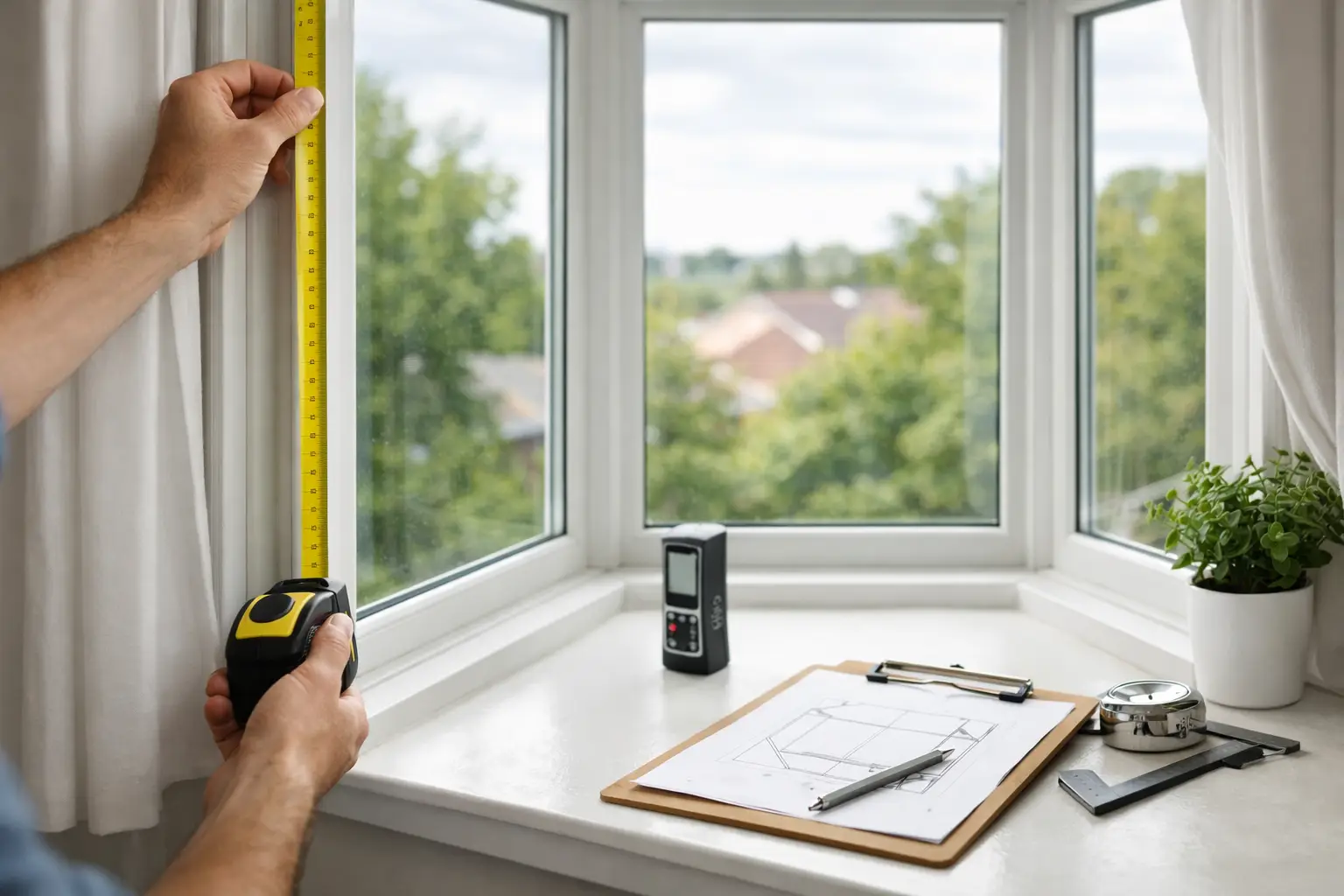
Bay windows rarely give you much room for guesswork. A few millimetres out can mean blinds that catch on each other, leave awkward gaps or simply do not sit neatly across the shape of the window. If you are wondering how to measure bay windows for blinds, the key is to slow down, measure each section properly and decide early whether you want a recess fit or an exact fit.
Unlike a standard flat window, a bay is made up of separate faces that meet at angles. That means you are not measuring one opening, but a set of connected spaces that need to work together. The right measurements help with privacy, light control and a clean finish, whether you are choosing roller blinds, Venetian blinds or vertical blinds.
Why bay windows need a different approach
A bay window projects out from the wall, so each pane or section usually has its own width, drop and angle. In some homes, the side sections are shallow and straightforward. In others, the angles are tighter, the frames are chunky and handles sit exactly where you do not want them.
This is why measuring bay windows is less about speed and more about accuracy. You need to think about how the blind will operate once fitted, not just whether it covers the glass. A blind that looks right on paper can still clash with handles, architraves or the neighbouring blind if the available space has not been checked.
Before you measure bay windows
Start with a steel tape measure rather than a fabric one. You will also want a notepad, a pencil and somewhere to record each section clearly. Label the window left, centre and right, even if your bay has more than three faces. It sounds basic, but it prevents confusion later.
Measure in millimetres, not centimetres. Most made-to-measure blinds are produced to the millimetre, and rounding up or down too early can create fitting problems. It also helps to decide what type of blind you want before measuring, because a roller blind, a Venetian blind and a vertical blind do not always need exactly the same clearance.
If your window has tiles, deep sills, protruding handles or vents, make a note of those as well. These details affect where the blind can sit and how neatly it will hang.
How to measure bay windows for blinds
The first decision is whether your blinds will sit inside the recess or outside it. For most bay windows, an inside recess fit is the tidier option, but it only works if there is enough depth and clearance for the blind type you want.
Measuring for a recess fit
For each individual section of the bay, measure the width in three places – top, middle and bottom. Use the smallest measurement. Then measure the drop in three places – left, centre and right – and again use the smallest figure.
This matters because bay windows are often not perfectly square, especially in older properties. If you only measure once, you might miss a slight narrowing at one point in the recess.
You also need to check the recess depth. A shallow recess may not allow the blind to sit properly, particularly with Venetian blinds that need room for the slats and headrail. If handles project into the space, measure from the front of the handle to the front edge of the recess to see how much room is truly available.
For roller blinds, think about where the fabric will fall. The bracket may fit inside the recess, but the rolled fabric can still catch if the handle sits proud.
Measuring for an exact fit
If you are fitting the blind outside the recess, measure the area you want the blind to cover rather than the opening itself. Take the width across each section and decide how much overlap you want around the frame. Then measure the drop from the planned fixing point to where you want the blind to finish.
This approach can work well when the recess is too shallow, the bay shape is awkward or you want better blackout coverage. The trade-off is that exact fit blinds can look more prominent, and in a bay they need careful planning so one blind does not interfere with the next.
Measuring each face of the bay properly
A common mistake is treating the centre section as the main measurement and the sides as an afterthought. In practice, each face needs equal attention because the overall result depends on how those blinds sit together.
Measure every section separately. Do not assume the left and right sides match, even if they appear symmetrical. In many bay windows, one side is slightly different due to plaster lines, frame position or previous alterations.
Write each width and drop next to the correct section name straight away. If one side section is narrower and has less recess depth, that may influence your blind choice across the whole bay.
Check the angles and blind clearance
The angles between sections affect how the blinds will operate. This is especially relevant with Venetian blinds or wider roller systems, where the headrail or brackets can project into the corner area.
Look at the distance from one window face to the next. If the blinds are fitted too close together without allowing for bracket depth or control mechanisms, they may knock against each other. This can make operation awkward and spoil the finish.
In practical terms, measuring a bay window is not only about width and drop. It is also about checking the available space at the joins. If you are unsure, that is often the point where a professional measure makes sense.
Blind type makes a difference
Not every blind behaves the same way in a bay window. The style you choose changes how you measure and what you need to allow for.
Roller blinds can be a smart, simple option for bay windows, especially when you want a neat, modern finish. They work well in individual sections, but you need to consider bracket positions, chain controls and how much room the roll takes up.
Venetian blinds are popular for bay windows because they suit both period and modern properties. They offer good control over light and privacy, but they also need enough clearance for slats to tilt freely. Handles can be more of an issue here than with some other blind types.
Vertical blinds are often used in larger bays, offices and commercial spaces. They can handle wide openings well, but the headrail and vane stack need proper planning so the blind opens cleanly without crowding the bay.
If you are measuring before choosing a style, record as much detail as possible. That gives you more flexibility later.
Common measuring mistakes to avoid
Most problems come from assumptions rather than complicated maths. Measuring only once, switching between centimetres and millimetres, or forgetting to account for handles are all easy mistakes to make.
Another common issue is ordering to the exact recess size without checking whether the supplier makes deductions for fitting tolerance. Some made-to-measure blinds are supplied with those allowances built in, while others expect the customer to provide a finished size. That distinction matters.
It is also worth being realistic about older bays. Walls and frames can be uneven, and timber features may not run perfectly true. A slight variation across the recess is normal. The goal is not finding a perfect shape, but getting the most accurate working measurements for the blind.
When professional measuring is the better option
Some bay windows are straightforward. Others are not. If your bay has tight angles, limited recess depth, multiple handles, shutters nearby or a mix of opening styles, measuring can quickly become less straightforward than it first appears.
That is where a professional service saves time and hassle. A specialist can advise not just on how to measure bay windows, but on which blind type will suit the space best and how each section should be fitted for the cleanest result. For homeowners, landlords and business premises alike, that extra accuracy often prevents costly reordering.
At Queen Blinds, measuring is part of making the whole process easier. Instead of second-guessing widths, recesses and clearances, you can get practical advice based on the shape of your actual window and the finish you want.
A few final checks before ordering
Before placing any order, go back through your notes and make sure every section is labelled clearly. Confirm whether your measurements are recess or exact fit, check that all figures are in millimetres and make sure any obstructions have been noted.
If possible, measure twice on separate occasions. Fresh eyes often catch a missed detail, especially on bays where one section differs slightly from the others.
A bay window can be one of the best features in a room, and the right blinds should sharpen that effect rather than fight against it. Take your time with the measurements, and if the shape feels awkward, get expert help before the blind is made.